CoBrA
The capybara turns sharply in front of a great wall of paper. A wide brush is in one paw; the other has just left a print in the paint. Out of red, blue and yellow patches a fantastic bird, a snake and a very silly mask are appearing.
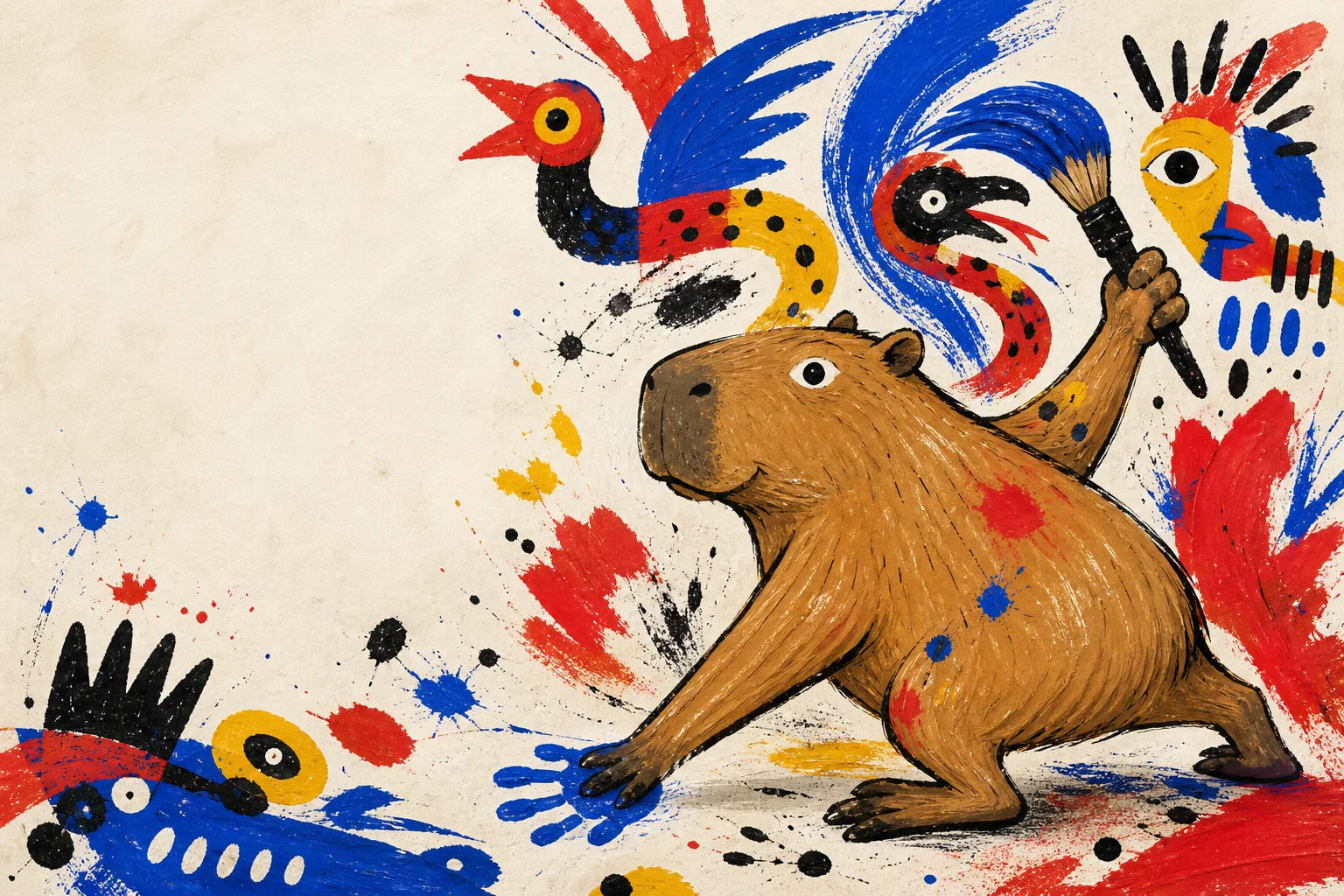
“It started as a blot. It has opinions now.”
What CoBrA was
CoBrA was an international group of artists that formed in 1948 and worked energetically until 1951. Its name is made from the first letters of three cities: Copenhagen, Brussels, Amsterdam.
Its members were not trying to invent one tidy style. What joined them was the wish to free art from academic rules — to work boldly, quickly, and together. They valued children's drawing, folk art, myths, imaginary animals, and the visible trace of a direct gesture.
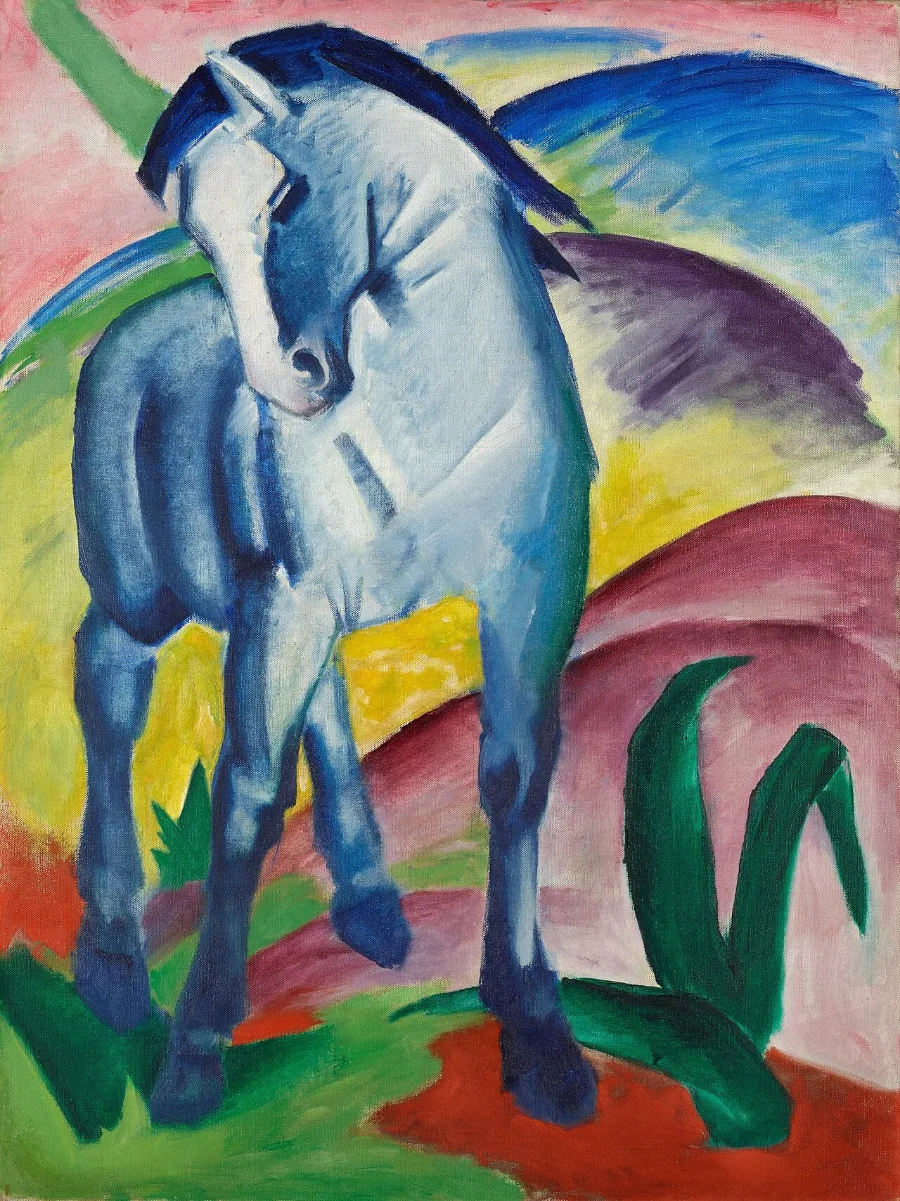
They said so themselves, and this is one of the pictures they meant. Franz Marc painted a blue horse in 1911. Nobody has ever seen a blue horse, and nobody looking at this one is confused for a second.
Art after a catastrophe
The group appeared shortly after the Second World War. These artists wanted to begin again and find a language that carried none of the cold officialdom, the discipline or the crushing of the individual they had just lived through.
Instead of flawless technique they chose the living mistake. Instead of the lonely genius, work made together. Instead of a composition worked out in advance, a picture able to change while it was being made.
Our capybara stands in front of a clean wall and is not afraid of the first uneven mark. That mark is what starts everything else.
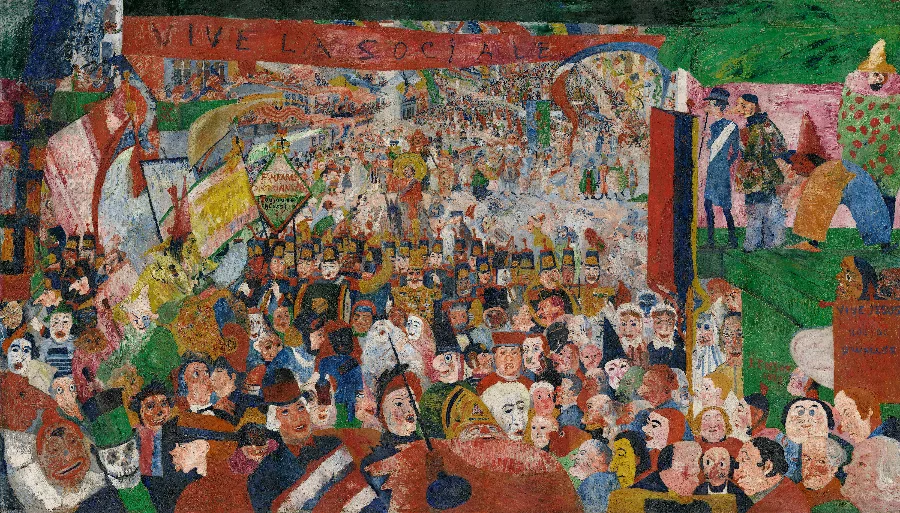
There was a Belgian ancestor for this, sixty years earlier. James Ensor filled a street with masks in 1888 and was laughed at for it. CoBrA claimed him, and so did half of modern painting afterwards.
The main principle: impulse and answer
The CoBrA artists were interested in automatism — working so that the movement of the hand runs ahead of the mind's strict control. One sign calls up the next: a blot becomes an eye, a line becomes a tail, an accidental print becomes a new character.
Fact card. This did not mean the absence of skill. The artist watches the forms that have appeared and answers them, as in a conversation. The work grows like a game rather than following a plan.
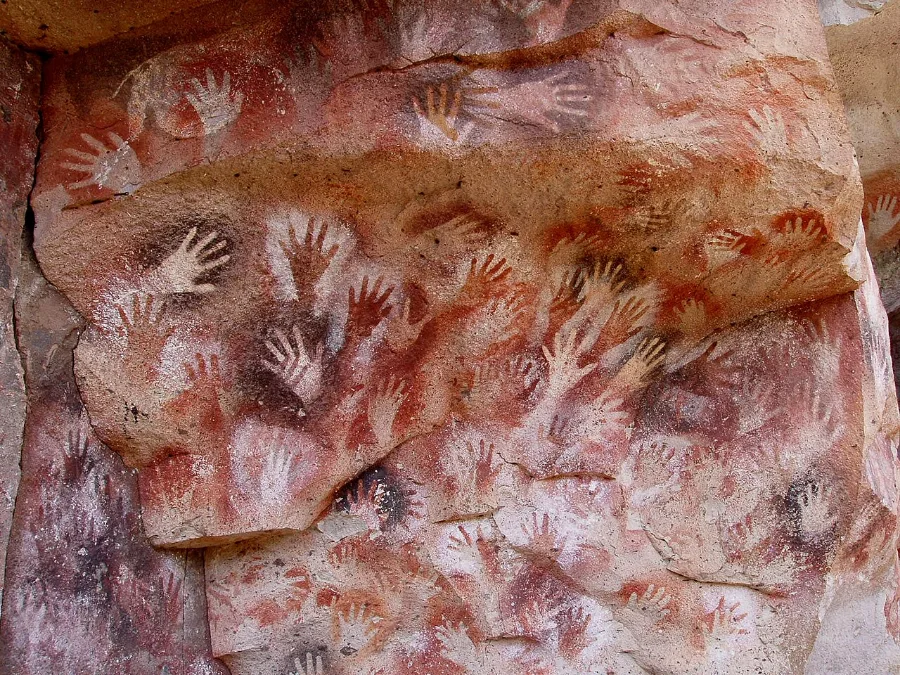
People have been answering each other this way for a very long time. These hands were stencilled onto a wall in Patagonia about nine thousand years ago, one over another, by many people across many lifetimes. Nobody rubbed anybody out.
Looking closely at our capybara
Press the numbers.
Pick a number
Each marker points at one thing this movement cared about.
Observation. The capybara stays completely recognisable — barrel body, blunt muzzle, small round ears — while everything around her comes apart into pure energy.
Asger Jorn and Constant
Asger Jorn
The Danish painter joined mythic images, harsh lines and thick colour. His creatures often seem funny, unsettling and extremely alive all at once. From him our scene takes its uneven texture and its sense of things turning into other things.
Constant Nieuwenhuys
The Dutch painter helped found CoBrA and believed that making things should be part of a free life rather than a privilege of museums. His early work is full of fantastic beasts and bright, tense combinations of colour.
Worth knowing. You have reached the end of the series without seeing a single CoBrA painting, and there is a reason with dates on it. A work stays in copyright for seventy years after the artist dies. Jorn died in 1973, Dotremont in 1979, Constant in 2005, Appel in 2006 and Corneille in 2010 — so the first of them can be shown here in 2044, and the last in 2081. The drawings on these two screens and the next are ours: not their pictures, but how each of them put the paint on. Everything else in this chapter is what they told us they were made of.
Karel Appel, Corneille and Dotremont
Karel Appel
Became known for powerful patches of colour and figures like children's masks. His painting only looks simple: colour, rhythm and the pressure of the brush hold the image together very carefully.
The CoBrA vocabulary
A wild outline
The line does not have to be even. Its thickness and speed carry the energy of the hand.
Primary colour
Red, blue and yellow work openly and collide with each other, with no soft transitions in between.
A creature from a blot
An eye, a beak or a paw is added to an accidental shape — and the abstraction becomes a character.
How to spot a CoBrA work
Check for six things: a figure drawn freely, almost childlike; a thick, living, uneven outline; bright and often clashing colours; masks, birds, snakes and invented beasts; visible traces of the process — splashes, runs, prints; and a picture that carries impulse and feeling more strongly than an accurate likeness.
Worth knowing. Children's drawing was not being imitated as a joke. These painters thought a child draws what matters rather than what is there, and they wanted that back.
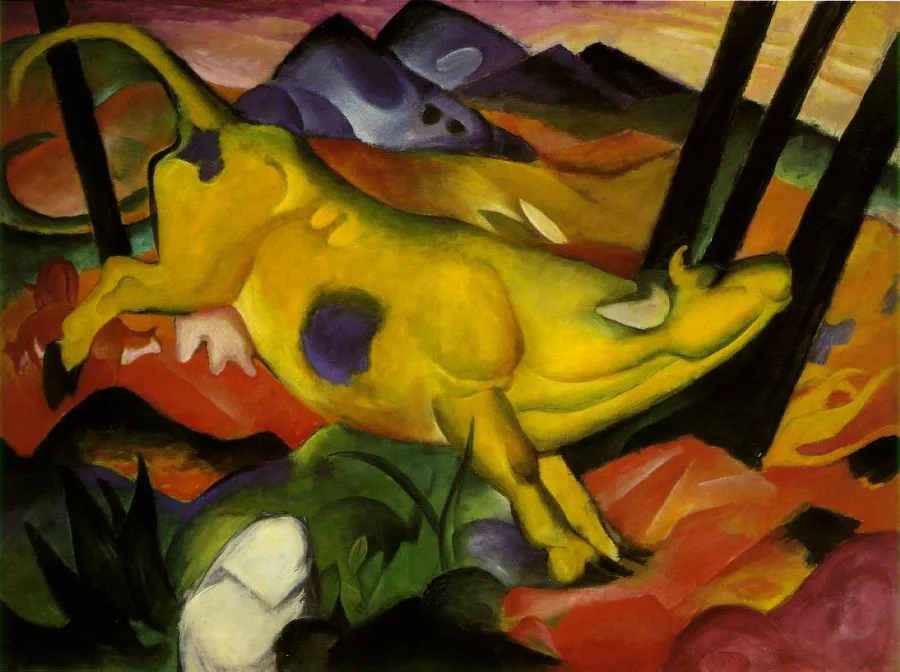
Practise on this one, then. Franz Marc again, the same year: a yellow cow, mid-leap, on blue hills. Bright clashing colour, an invented beast, and feeling carried further than likeness — that is four of the six already.
Instinct or control?
Which of these belong to the spirit of CoBrA?
Leaving an uneven brushmark — yes. Aligning every line to a grid — no. Turning a blot into a bird — yes. Hiding every splash — no. Letting a friend continue your drawing — yes. Copying a famous painting as exactly as possible — no.
Notice that four of the six are about not doing something. Restraint is doing a great deal of the work in a style that looks like it has none.
Creative workshop: a collective creature
Worth knowing. What you need: a big sheet, gouache or markers, wide brushes, sponges and coloured paper. And at least two other people.
- The first person leaves a blot or a wide line.
- The second adds an eye, a paw, a beak or a tail to it.
- The third brings in a contrasting colour and one more character.
- Nobody works for longer than a minute, and nobody erases anyone else's marks.
- At the end, the group gives the creature a name and a short story.
The rule that makes this work is the one about not erasing. It turns separate gestures into a conversation instead of a competition.
What to keep
“The capybara steps back from the wall. What is in front of her is not a tidy portrait but a whole world: birds arguing with snakes, handprints turning into stars, and colours that seem to still be making a noise.”
That is the end of the series so far. Eleven movements, one capybara, and a great many ways of deciding what a picture is for.
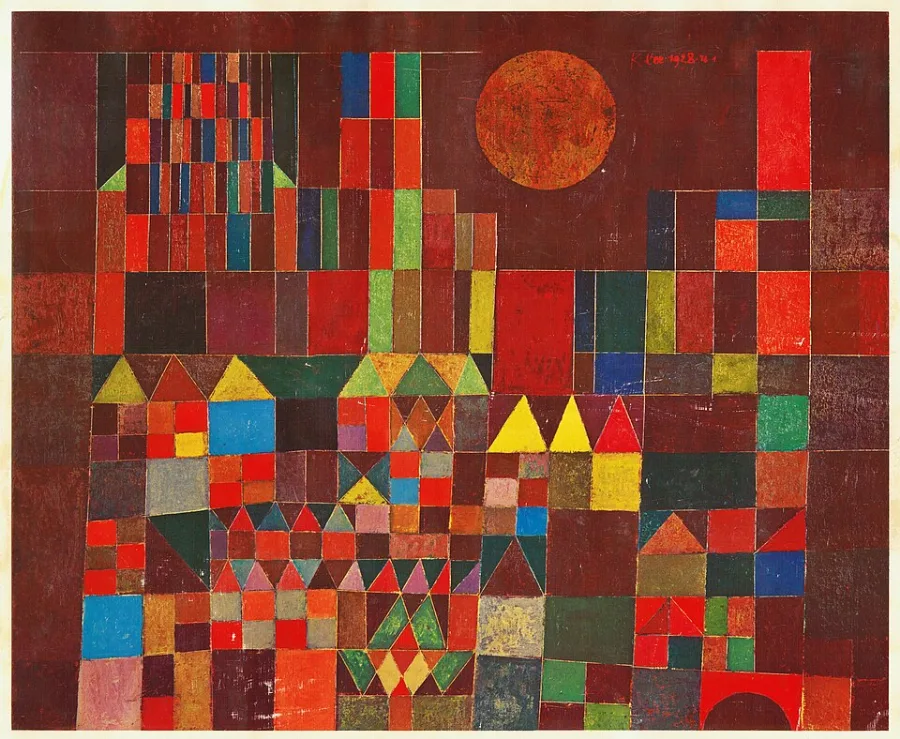
And the last picture goes to Paul Klee, who died in 1940 and whom every one of these painters named. He drew like a child on purpose, for thirty years, and it took him a lifetime to learn how.
1. Where does the name CoBrA come from?
Three cities, three groups of artists, one very short-lived alliance.
2. When was the group active?
Barely three years, shortly after the Second World War.
3. What did the CoBrA artists value?
They were looking for a language with none of the coldness they had just lived through.
4. Who is known for powerful colour patches and masklike figures?
It looks simple. Holding it together is not.
5. What does automatism mean in this chapter?
One sign calls up the next. A blot becomes an eye becomes a bird.
6. In the collective workshop, what is the one rule that matters most?
That rule is what turns separate gestures into a conversation.