Dada
A capybara runs onto the stage in a cardboard costume, blows a paper megaphone and scatters torn newspaper behind her. She has not spoiled anything. Here, the disorder is the artistic method.
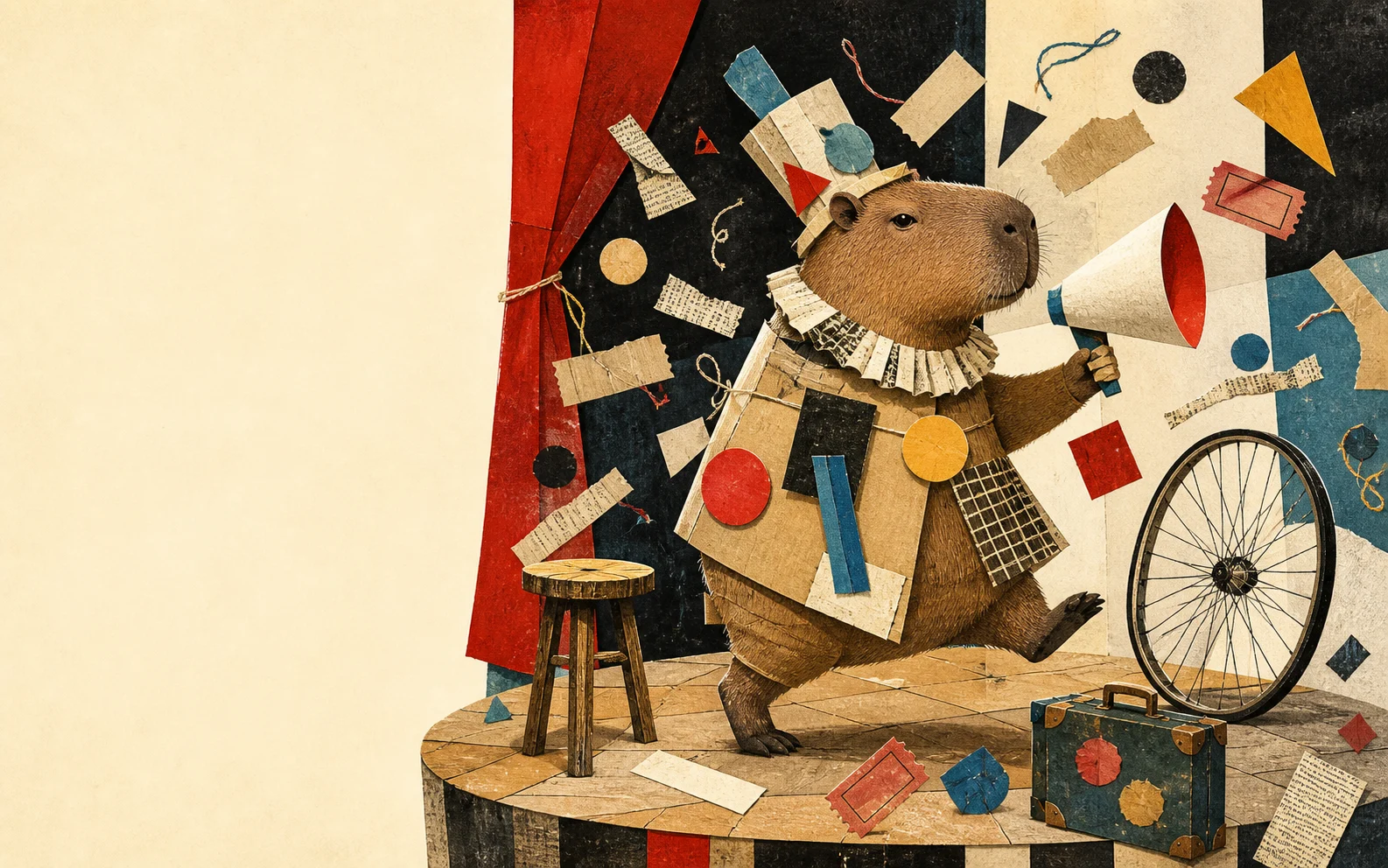
“I am not sure what this is either. That appears to be correct.”
Art after a shock
Dada began during the First World War. To many young artists, the familiar words about order, progress and civilisation had stopped sounding true: a European culture that was proud of its reason had arrived at mechanised destruction.
Instead of offering another beautiful system, the Dadaists offered doubt. They put together random words, found objects, newspaper photographs, noise, dance and provocation. Their work could be funny, uncomfortable or deliberately absurd. What mattered was the question underneath: if the world has lost its sense, must art go on pretending everything is fine?
Dada had no single style. It became an international network of independent scenes — Zurich, New York, Berlin, Hanover, Cologne, Paris.
Dada was less a picture of a new world than a test of how solid the old one really was.
Zurich, 1916
In neutral Switzerland, émigrés, poets and artists gathered in a small Zurich cabaret. They read sound poems, played music, danced in strange costumes and put on evenings that were part performance, part argument, part friendly catastrophe.
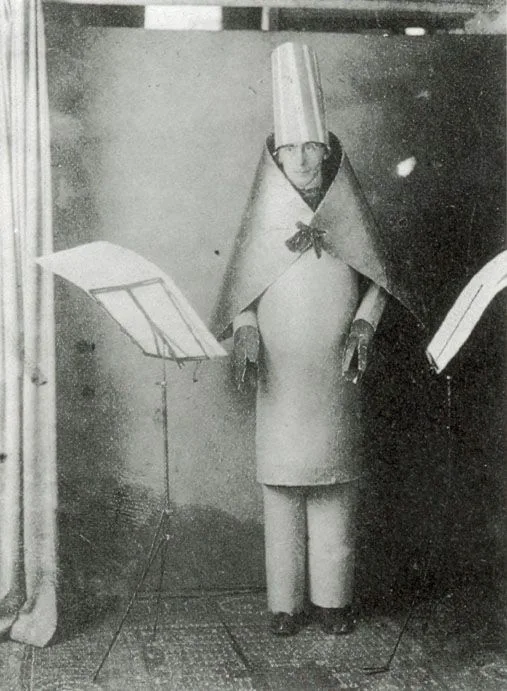
One photograph survives from those evenings. Hugo Ball is standing in a costume of stiff cardboard tubes, reading a poem made of invented words. He looks completely serious, which is the joke and also not the joke at all.
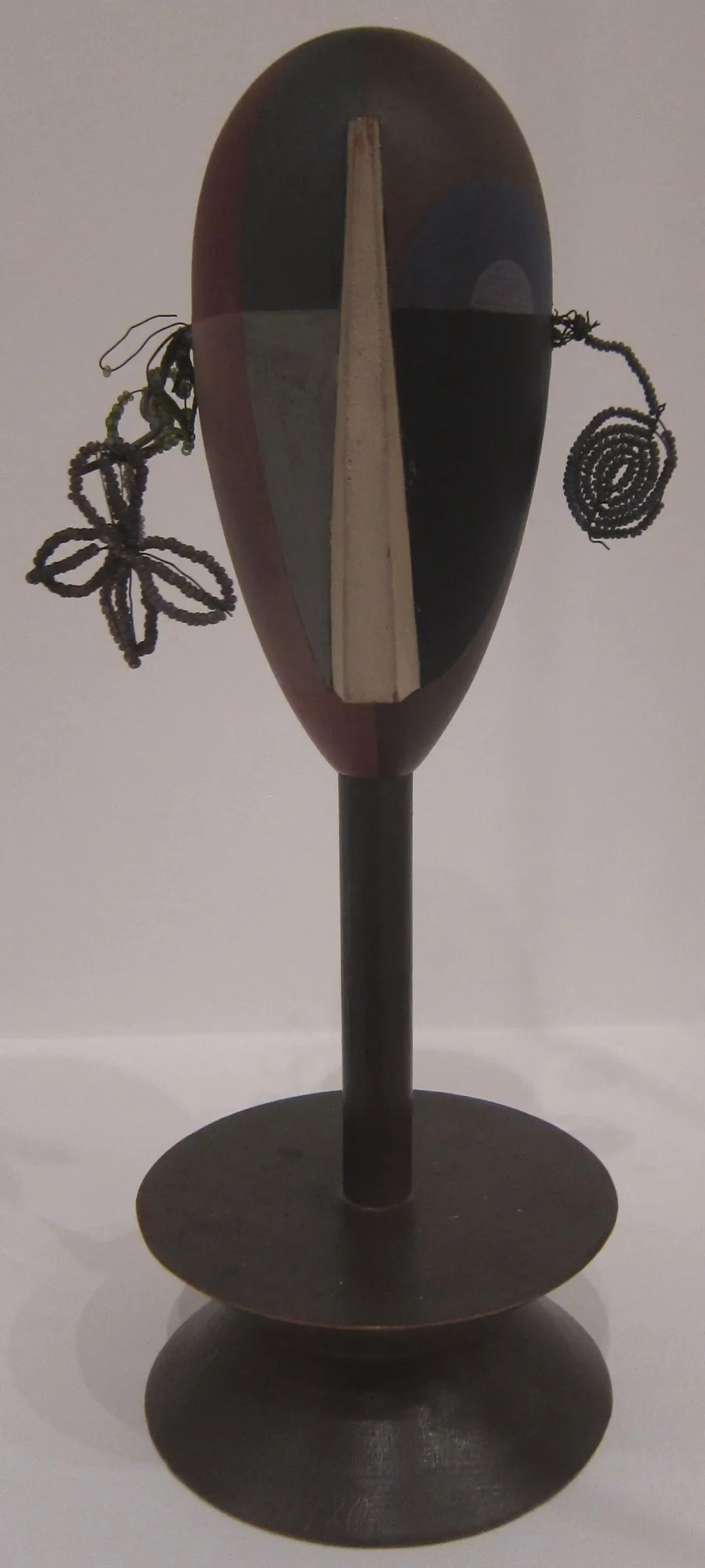
Sophie Taeuber-Arp danced at the cabaret and made objects for it. Her carved wooden heads look like something between a hat stand, a puppet and a person, and they are still hard to place a hundred years later.
The name “Dada” is surrounded by stories too. One says the word was found by chance in a dictionary; another that they liked its childlike simplicity and its many meanings. The most honest thing to say is that there is no single confirmed explanation — which suits a movement that distrusted final answers rather well.
Fact card. A Dada evening could contain painting, poetry, music, masks and noise at once. The borders between art forms were being rubbed out on purpose.
Chance takes the leading role
A traditional artist decides in advance what the work should become. A Dadaist might do the opposite: throw scraps of paper onto a table and leave them where they fall, or pull words out of a bag and make a poem in whatever order they came.
That method loosened the author's control. The work was born from a collision between intention and surprise.
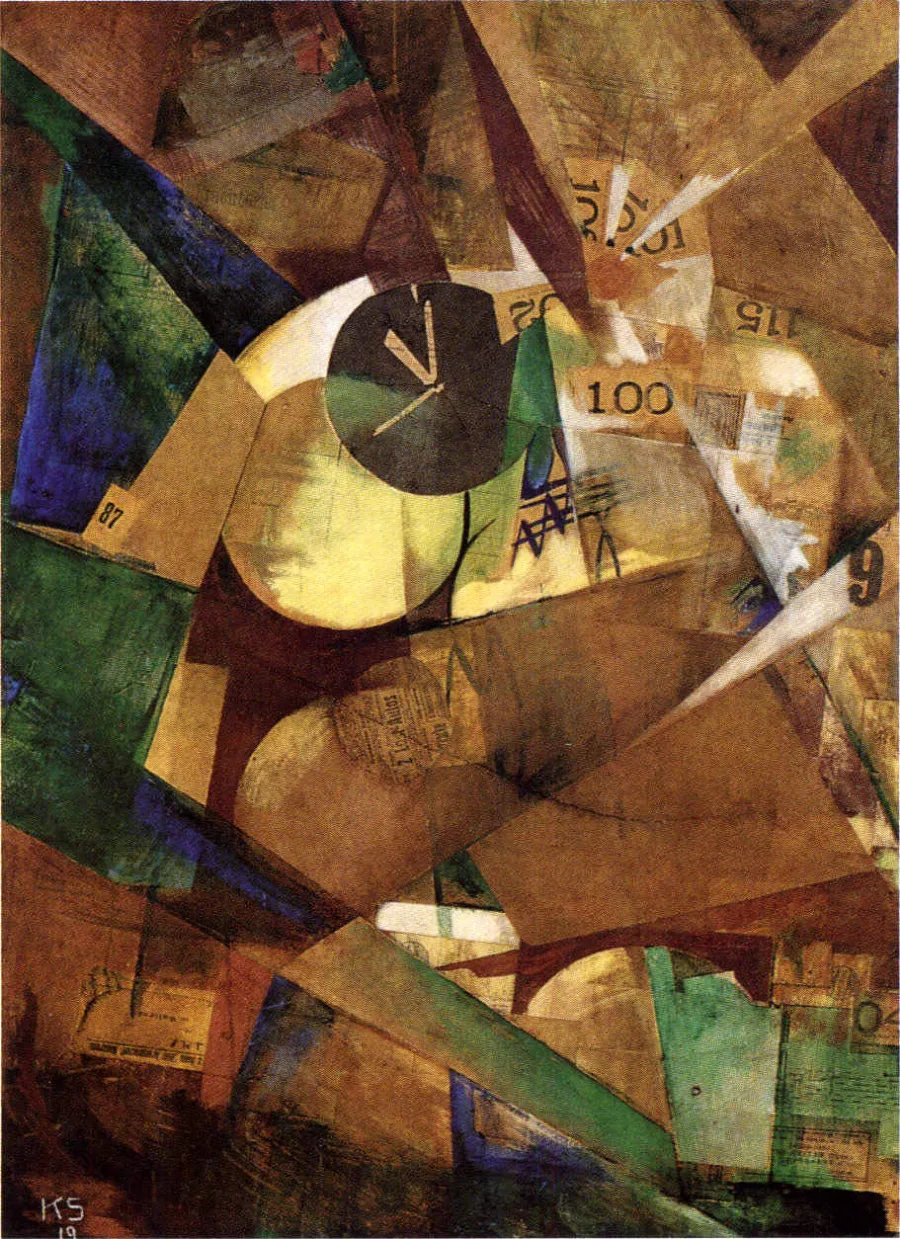
Kurt Schwitters went on working this way for thirty years. This one is from 1946 — coloured papers overlapping as though they had just landed, and then been left exactly where they fell.
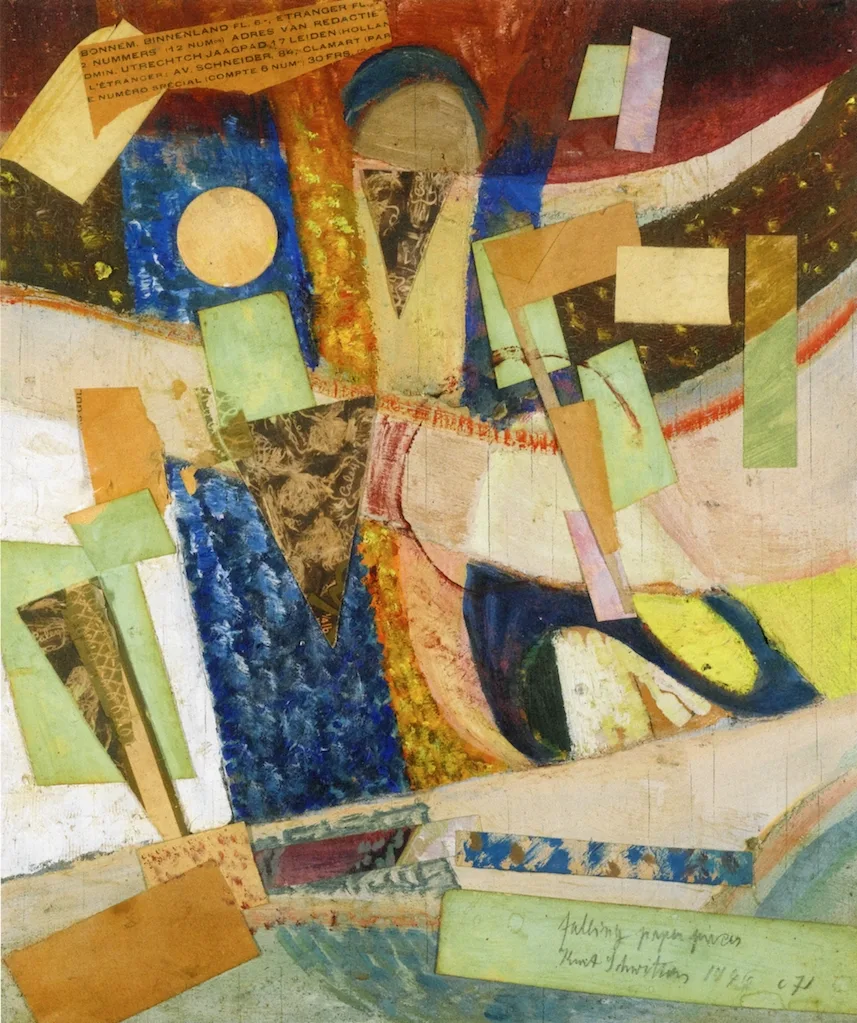
Worth knowing. The rule is not “anything goes”. Chance proposes; the artist notices, chooses and answers. Somebody still has to decide when it is finished.
Looking closely at our scene
Press the numbers to find what our Dada capybara is made of.
Pick a number
Each marker points at one thing this movement cared about.
Observation. The capybara stays calm in the middle of visual noise. The whole joke rests on that contrast.
The readymade
Marcel Duchamp used the word readymade for ordinary manufactured things that he chose and presented as art. The gesture looked simple, but it changed the main question. Instead of how skilfully was this made? the viewer had to ask: why is this object here, and what changed when the artist chose it?
The readymade moved attention from a beautiful surface to the idea, the title, the context and the decision. That turn had an enormous influence on the conceptual art of the later twentieth century.
Worth knowing. This chapter shows you no Duchamp, no Hannah Höch and no Jean Arp, and that is not because we could not find them. A work stays in copyright for seventy years after the artist dies, and those three are protected here until 2039, 2049 and 2037. So where you would expect their pictures, you will find our own drawings and a note like this one. Kurt Schwitters died in 1948, which is why he is the artist you actually get to see.
What changes an object more — the hand of a craftsman, or a new thought about it?
Photomontage
The Berlin Dadaists worked hard with newspapers and magazines. Photographs of politicians, machines, advertised goods and perfect faces were cut up and joined into sharp, impossible scenes. A visible seam was a virtue: it showed that the familiar picture of the world is also something somebody assembled.
Hannah Höch became one of the great masters of photomontage. She used mass images to criticise politics, the culture of the Weimar Republic and the roles society pressed onto women. Her compositions are funny, precise and unsettling all at once.
Fact card. Collage does not hide the join. It teaches you to notice the joins everywhere else.
Found materials
The Dadaists widened the list of what art could be made of: a tram ticket, packaging, a printer's letter, a wood shaving, a piece of machinery. Kurt Schwitters built a whole world of collages and room-sized constructions out of such leftovers and called it Merz.
Jean Arp went the other way, exploring soft organic shapes and letting elements fall where they would. The two approaches look nothing alike, but both refuse the idea that art requires noble materials and a composition approved in advance.
Dada on the map
What changed
Before Dada, people often asked
How convincingly is the object depicted? How brilliant is the artist's technique? Is the work beautiful? What did the artist mean to show?
Dada made people ask
Why was this object chosen? Can choosing be a creative act? Must art be beautiful at all? How does the context change the meaning?
Fact card. Dada came out of a real historical crisis. Its humour was not simply entertainment: behind the absurdity lay a distrust of propaganda, of social hierarchies, and of language used to excuse violence. We can play with the form without turning a war into decoration.
Creative workshop: a chance portrait
- Collect ten small pieces of paper you were about to throw away: tickets, envelopes, packaging without recognisable logos.
- Drop them onto a sheet from a height of about thirty centimetres. Do not move them.
- Look at where they landed and find an animal in the arrangement.
- Now you may add: glue them down, draw three lines to bring out what you saw, and nothing more.
- Give it a title that has no obvious connection to the picture.
- Read the title aloud in a serious voice. That is the whole performance.
The hardest instruction on that list is number two. Leaving the accident alone is a skill, and it takes practice.
What to keep
“Cubism took the picture apart. Dada took apart the idea of what art is allowed to be.”
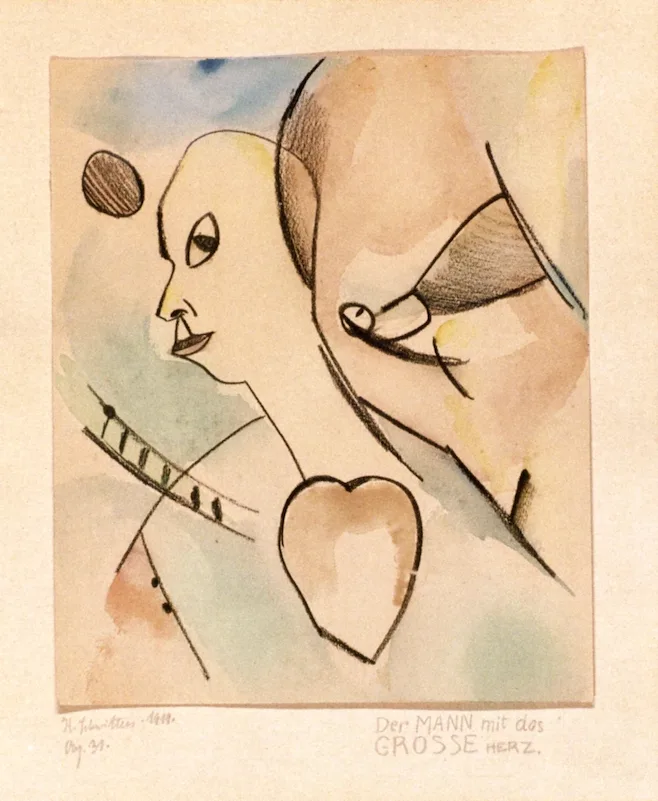
Schwitters drew this face in 1919, in a few thin lines, next to a heart the size of its head. It is silly, and it is tender, and it was made in a country that had just lost a war. Dada could hold all three at once.
Our capybara puts down the megaphone. In the next chapter she meets people who wanted the opposite of chaos: straight lines, three colours, and rules they were willing to argue about for years.
1. Did Dada have one required style?
Zurich, Berlin and New York produced work that looks nothing alike.
2. What turns an ordinary object into a readymade?
The gesture is the work. The object may be untouched.
3. What is characteristic of photomontage?
Hannah Höch used those visible joins as an argument in themselves.
4. What does chance do in Dada?
Chance proposes; somebody still decides when to stop.
5. Why did Dada use humour and absurdity?
Behind the jokes lay distrust of propaganda and of the language that excused a war.
6. Where did Dada begin?
Neutral Switzerland, in the middle of the First World War.