Fauvism
The capybara has just broken into a run. The leaves are swinging, the flowers have stepped aside, and behind her the path is a streak of hot colour. Here the paint does not wait for nature's permission: it decides the mood of the picture itself.
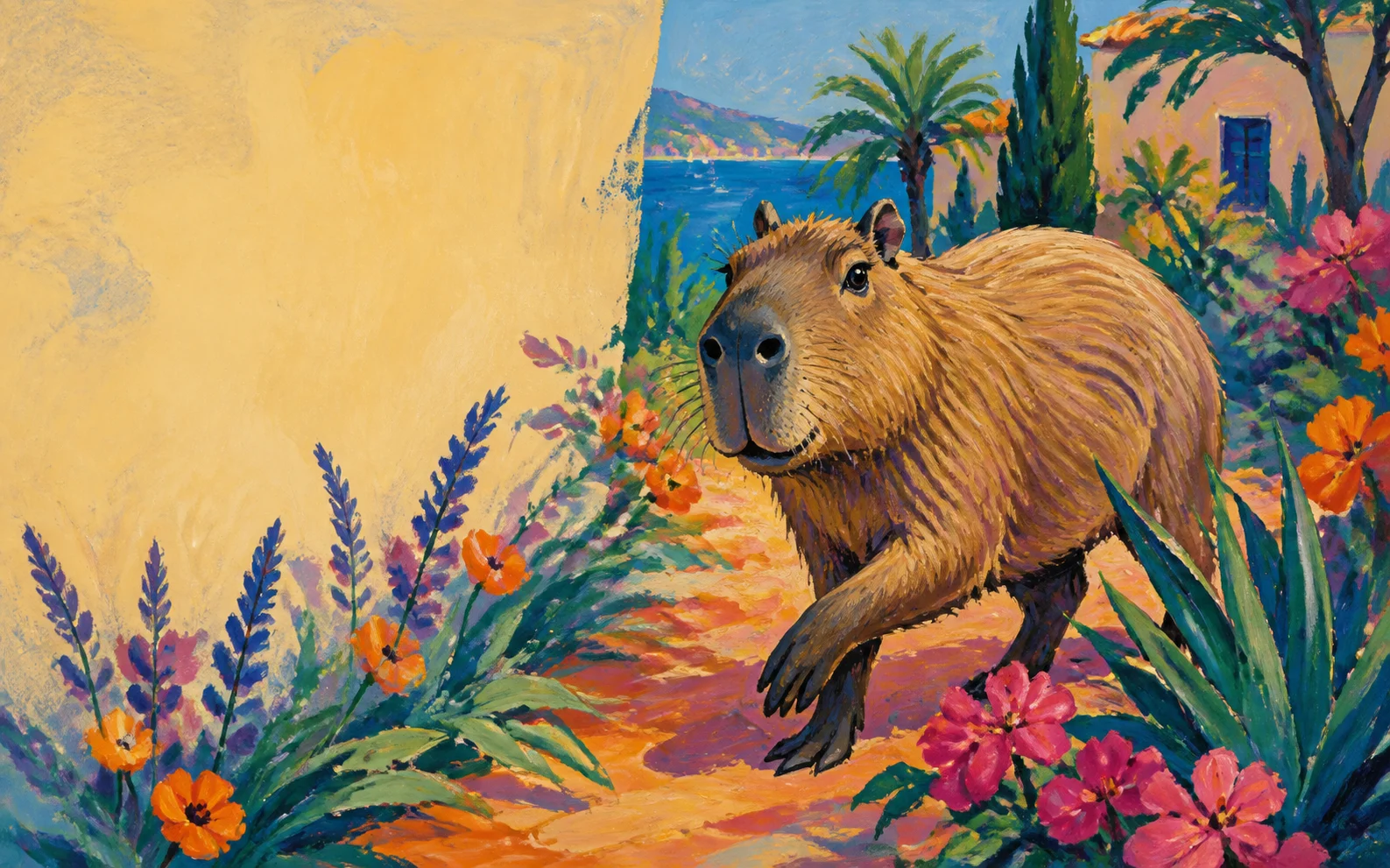
“I am aware the ground is not really orange. I have decided not to mention it.”
What Fauvism is
Fauvism appeared in France in the first years of the twentieth century. Its painters used open, saturated colour, visible brushmarks and simplified shapes. They were not trying to reproduce the surface of the world unnoticed. Quite the opposite: every stroke was meant to remind you that this is a painting, made by a person.
Instead of a believable green, a painter might choose cobalt blue. Instead of a skin tone — orange, pink or green. Colour stopped being the servant of the object and became a way to build a composition and to carry heat, joy, unease or movement.
Fauvism did not last long. But it left painters an important permission: reality does not have to be copied. It can be translated into your own language of colour.
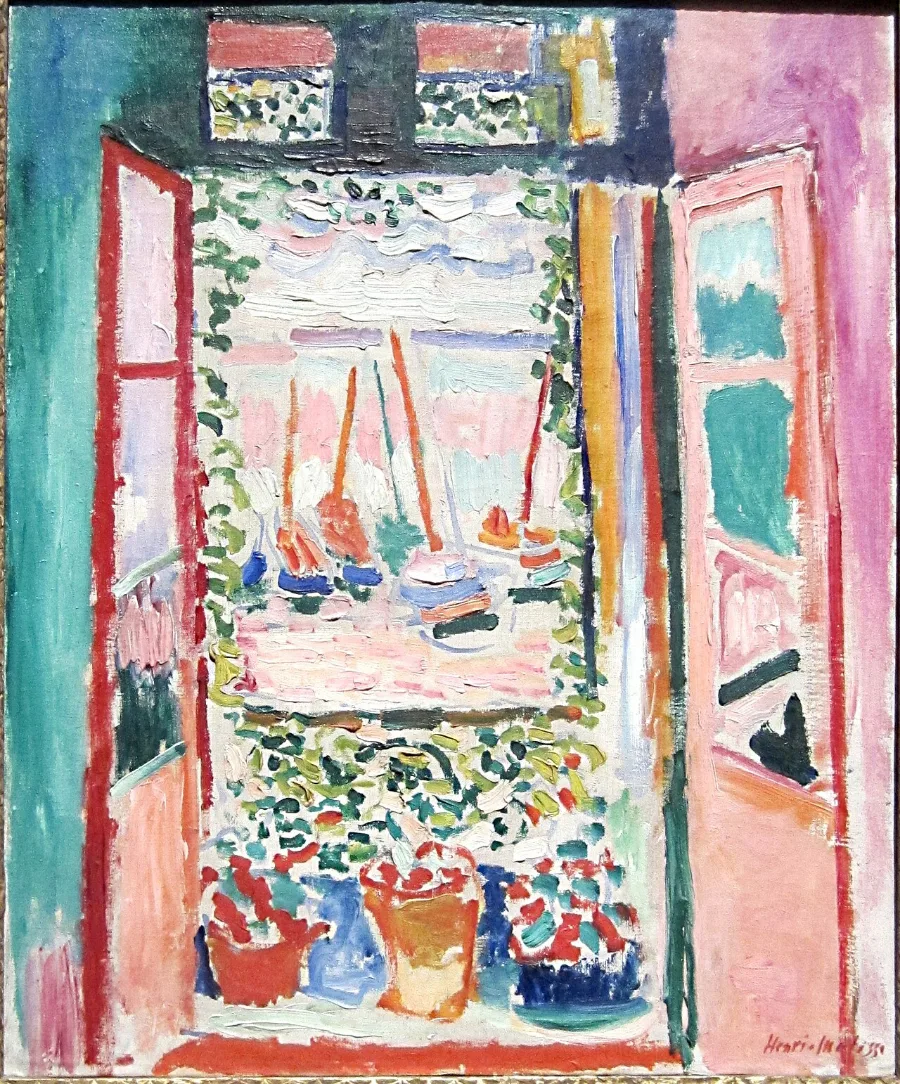
Here is the permission being used. Matisse painted this window in Collioure in 1905: the wall is pink, the frame is green, and the sea is made of pink and turquoise. You have never seen a sea that colour, and you know exactly what it is.
Why they were called wild
In the autumn of 1905, visitors to the Paris Salon d'Automne found the paintings of Henri Matisse, André Derain, Maurice de Vlaminck and others hung together in one room. The canvases stood out for their harsh colour combinations and bold handling. The critic Louis Vauxcelles called the painters in that room les fauves — the wild beasts. It was meant as mockery. It became the name of the movement.
That same year Matisse and Derain worked in the southern town of Collioure. The bright Mediterranean light helped them arrive at a painting where colour carried not the local shade of a thing but the immediate sensation of it.
Fact card. The Fauves were not clumsy painters who muddled their colours by accident. Their boldness was deliberate: they knew the traditions well and chose to abandon part of them.
1905 is the year painting raised its voice.
Colour need not obey the object
In a traditional picture, colour often explains what you are looking at: a green leaf, a blue sky, brown fur. For the Fauves it reported not only what we see but how we experience it.
Relationships between colours replaced the usual modelling with light and shade. Blue next to orange makes both ring louder. Red next to green creates tension. Large flat areas of paint organise the space without a detailed illusion of depth.
Looking closely at our capybara
Our capybara is not sitting in a museum pose. She walks quickly through the garden, a front paw lifted, her head turned to you. The heavy round body stays recognisable, but the silhouette is simplified into large masses of colour. Press the numbers.
Pick a number
Each marker points at one thing this movement cared about.
Observation. Take away the colour and this is still a capybara walking through a garden. Take away the drawing and the colour alone still tells you it is hot.
Henri Matisse: building with colour
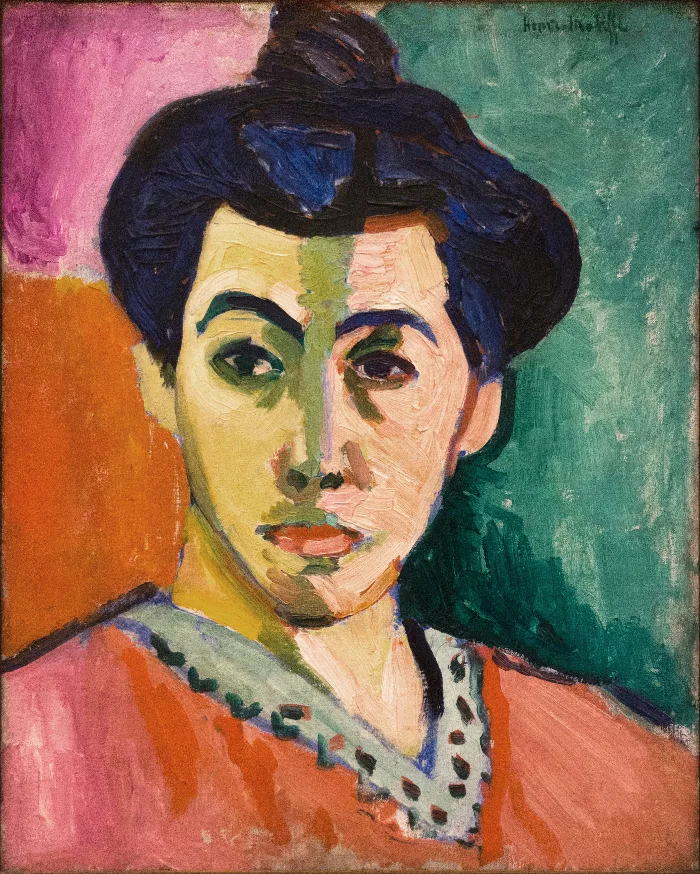
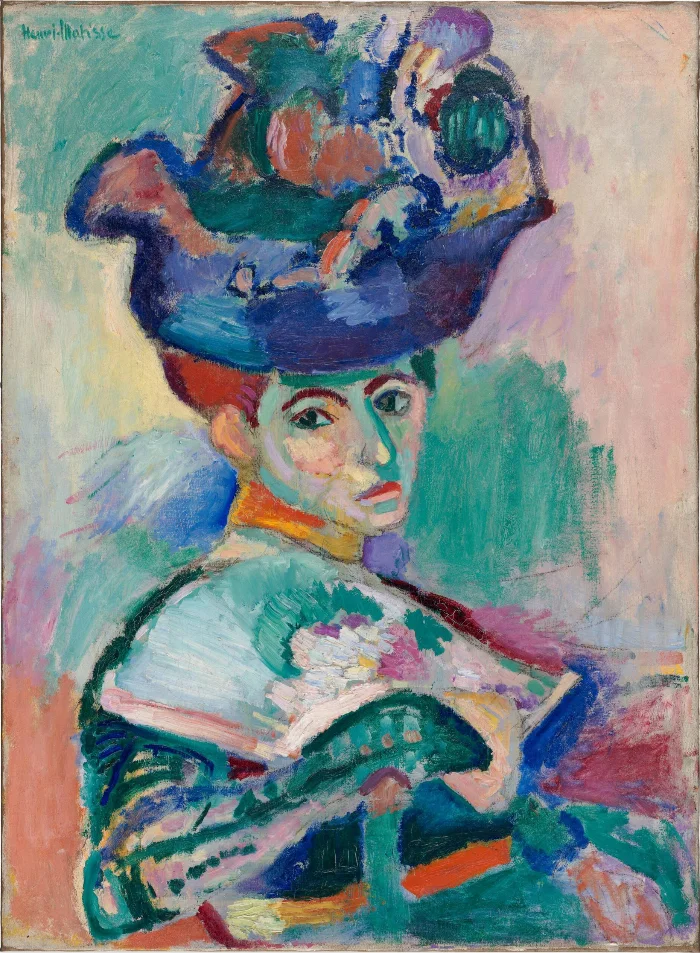
Matisse became the central figure of Fauvism. He wanted to construct a picture out of coloured surfaces, so that line, patch and background worked as one rhythm. In the portrait known as Woman with a Hat, and in The Green Stripe, the colour of a face does not obey natural colouring at all. A green line becomes a piece of construction, dividing the lit side from the shadowed one.
Matisse was not simply making everything brighter. He removed what was not needed, looked for balance between large masses of colour, and worked so that the eye could travel freely around the picture.
Fact card. Matisse's famous paper cut-outs belong to a much later part of his life. They can be mentioned as a development of his interest in pure form and colour, but they are not a Fauvist technique of 1905–1907.
André Derain: the light of Collioure
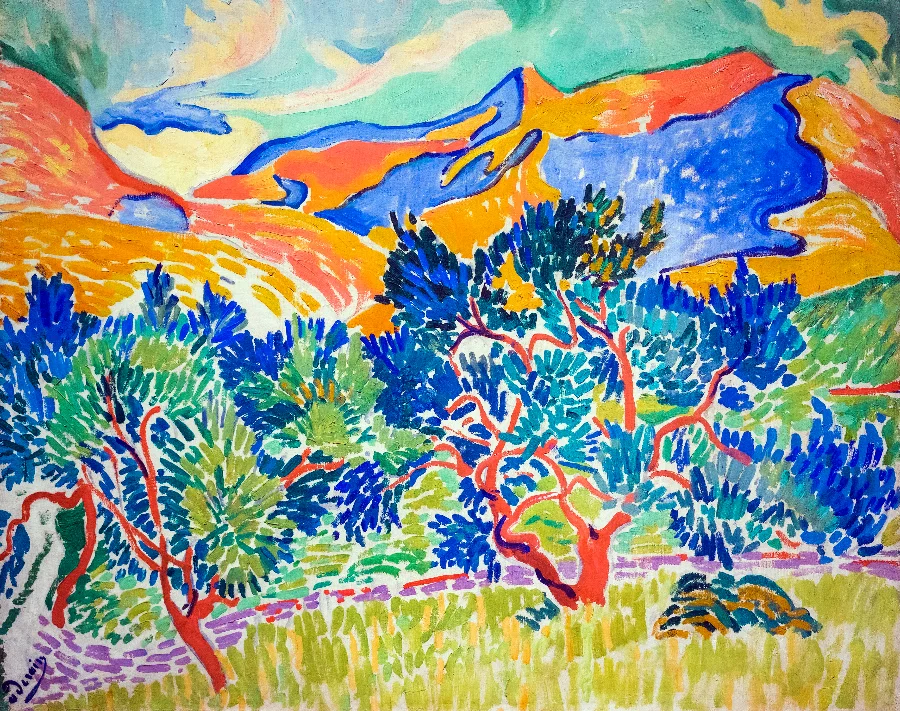
In the summer of 1905 Derain worked alongside Matisse at Collioure on the Mediterranean coast. Bright light, boats, water and hills became material for an experiment. Derain built a landscape from separate, energetic strokes of pure colour: water could be made of pink and green marks, a shore of orange and blue.
His pictures keep the place recognisable, but the colour makes it new. You are not looking at a photograph of a harbour; you are looking at the intensity of a summer day.
Maurice de Vlaminck, and the others
Vlaminck loved thick paint, sharp contrast and a sense of energy that will not be held back. His roads, trees and houses seem to resist calm. The paint does not hide behind the picture — it becomes its temperament.
The circle also included Kees van Dongen, Albert Marquet, Charles Camoin, Henri Manguin, Othon Friesz, Jean Puy, Louis Valtat and Georges Rouault. Georges Braque and Raoul Dufy came close to this language briefly before going their own ways.
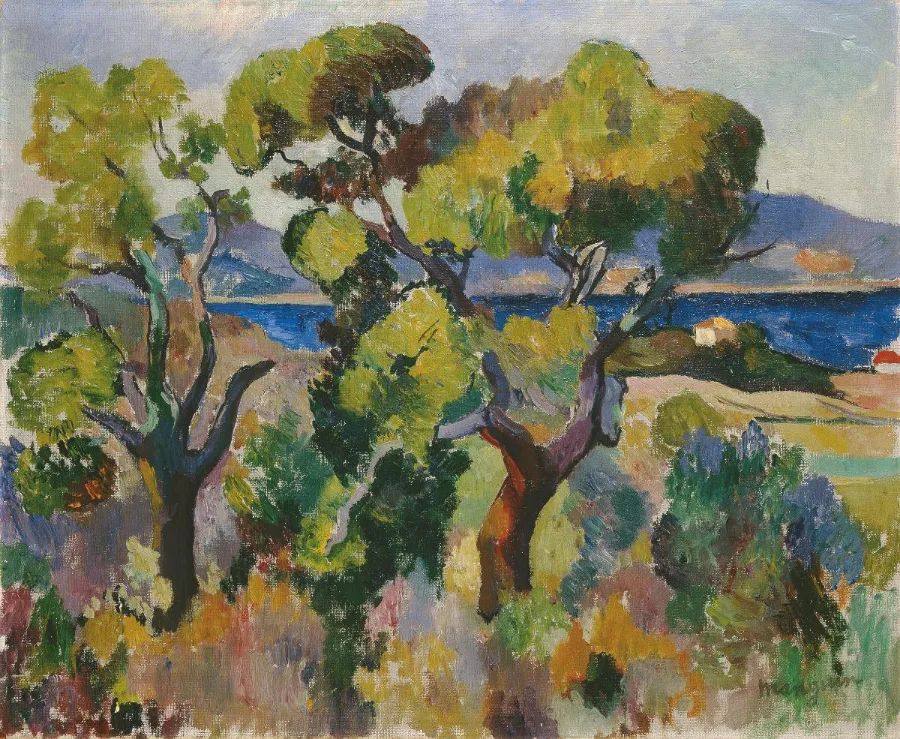
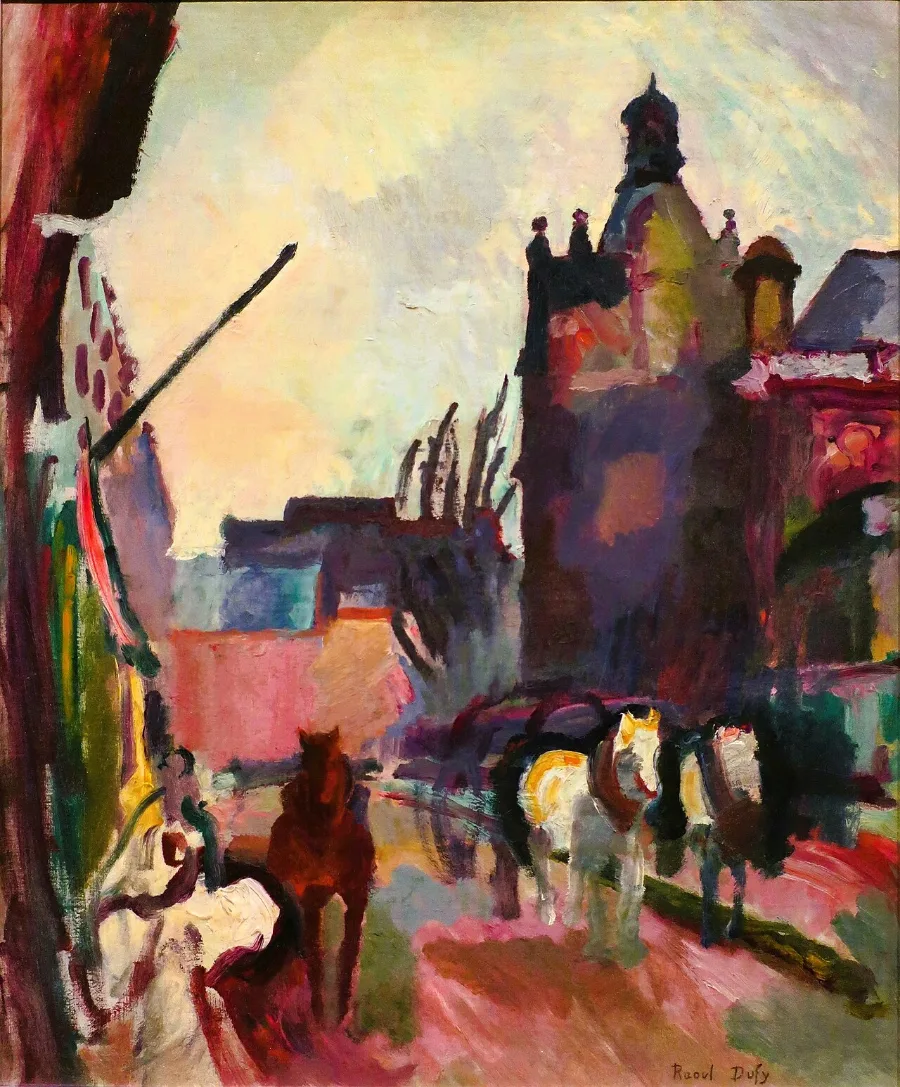
Two of those names, in the same summer of 1905. Manguin painted olive trees bending in the mistral, and Dufy painted horses in a street — both of them putting the paint on in slabs and leaving the canvas showing through.
How to spot a Fauvist painting
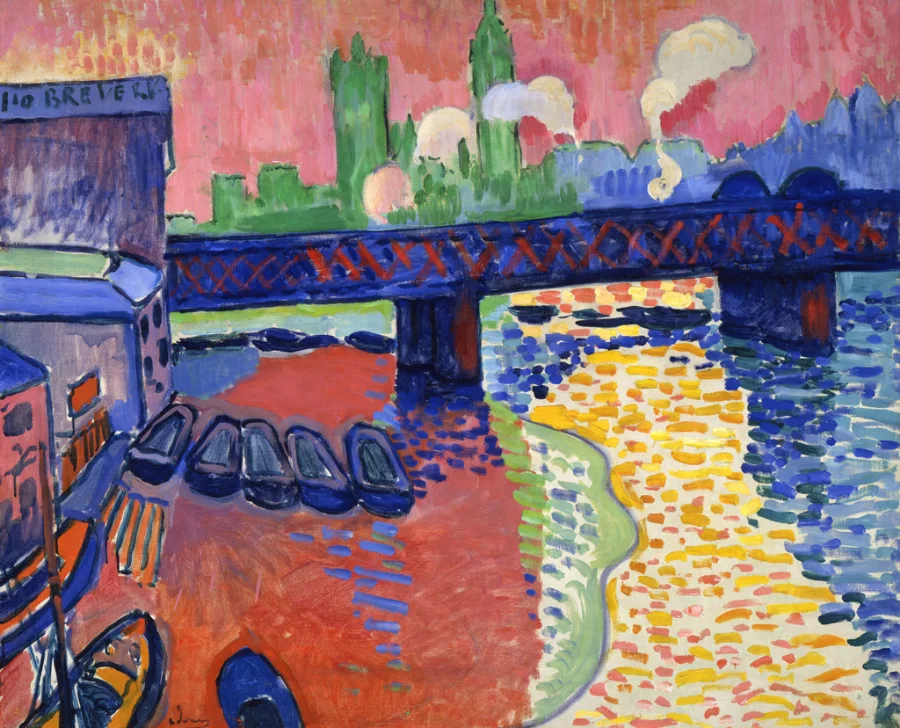
Look for a combination, not one single sign: bright and often unnatural colours; contrasting pairs of shades; free, clearly visible brushmarks; simplified forms with details left out; space built by colour rather than only by perspective; expression mattering more than likeness; and landscapes or portraits that look familiar and transformed at the same time.
Worth knowing. The quickest test is to ask what the colour is for. If it is describing the object, you are probably not looking at a Fauve. If it is describing the feeling, you probably are.
Four movements, four attitudes to colour
Impressionism
How is the visible light changing right now? Colour carries atmosphere and the light of a moment. Our capybara appeared by the water in one particular sunlit minute.
Post-Impressionism
How do I turn an impression into a personal system? Colour becomes structural or emotional. Our capybara sat inside a world of swirling brushmarks.
Creative workshop: a wild portrait
- Draw a large silhouette of a capybara, or any animal you know well.
- Choose one mood: delight, heat, curiosity, noise, or calm.
- Take four colours that suit that feeling best.
- Do not blend them smooth — leave the separate strokes and the living edges.
- Add one colour the animal definitely does not have in nature.
- Make the background a continuation of the movement, not a decoration behind it.
Fact card. Try it once with no brown and no natural green on your palette at all. Being unable to reach for the obvious colour is what forces an emotional decision.
Three questions afterwards: can a green face look truthful? What changes the mood more, the colour of the animal or the colour behind it? And when does brightness stop being cheerful and start being unsettling?
What to keep
“The Fauves set colour free. Next door, the Cubists are about to take form apart and show you an object from several sides at once.”
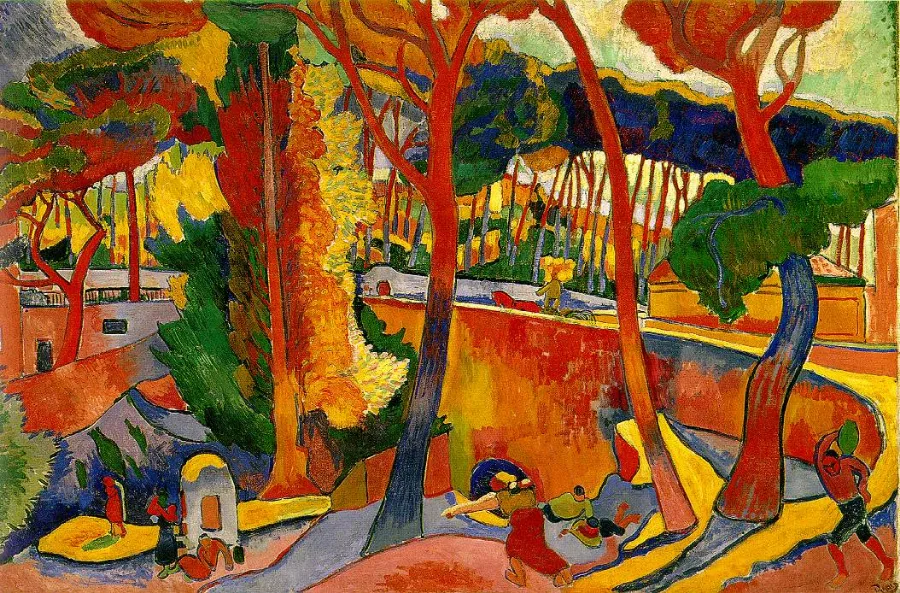
Derain, one more time, in 1906. The road is pink, the tree trunks are red, and the leaves are yellow. It is a perfectly ordinary corner of the south of France, translated.
1. Why were these painters called “the wild beasts”?
Louis Vauxcelles meant it as an insult. The painters kept the word.
2. What happened to colour in Fauvism?
A face could be green if green was what the moment felt like.
3. How do the Fauves create space in a picture?
Blue beside orange does more work than a vanishing point.
4. Which is true of Matisse's paper cut-outs?
They grew from the same interest in pure colour and form, decades afterwards.
5. Were the Fauves simply painters who could not mix colours properly?
Deliberate is the important word. You cannot abandon a rule you never learned.
6. What did Derain and Matisse find at Collioure in 1905?
The place mattered: the Mediterranean light made the experiment possible.