Pointillism
Stand close to this picture and you will see thousands of separate coloured dots. Take a few steps back and they turn into wet fur, sunlit water, reeds and a capybara who has just walked out of the river.
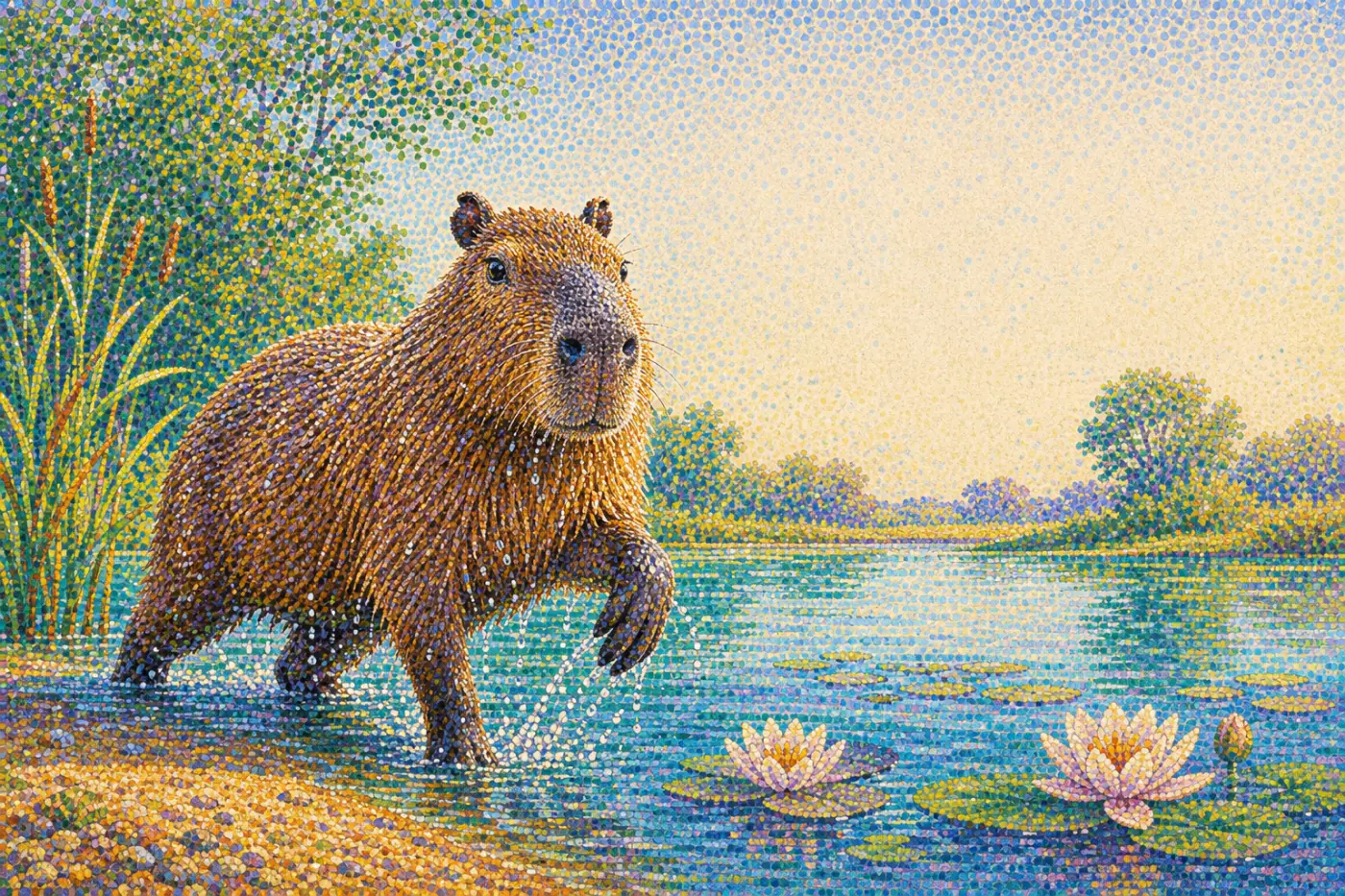
“Close up I am a whole crowd of dots. From over there I am one calm capybara again.”
From a free brushmark to careful arithmetic
The Post-Impressionists each looked for their own way of carrying colour and mood. Georges Seurat and Paul Signac went further still: they broke the picture down into small separate touches of pure colour.
Instead of mixing blue and yellow into green beforehand, a painter could set blue dots and yellow dots side by side. At a distance the eye joined them, and the surface began to look green — shimmering, and full of light.
Painting became a little like an experiment. The artist worked out the composition, the colour relationships, and the distance from which a viewer would see the whole. Yet the result stayed alive, like sunlight moving on water.
Slow, careful, calculated work — used to show a fleeting moment of light. That contradiction is the whole point.
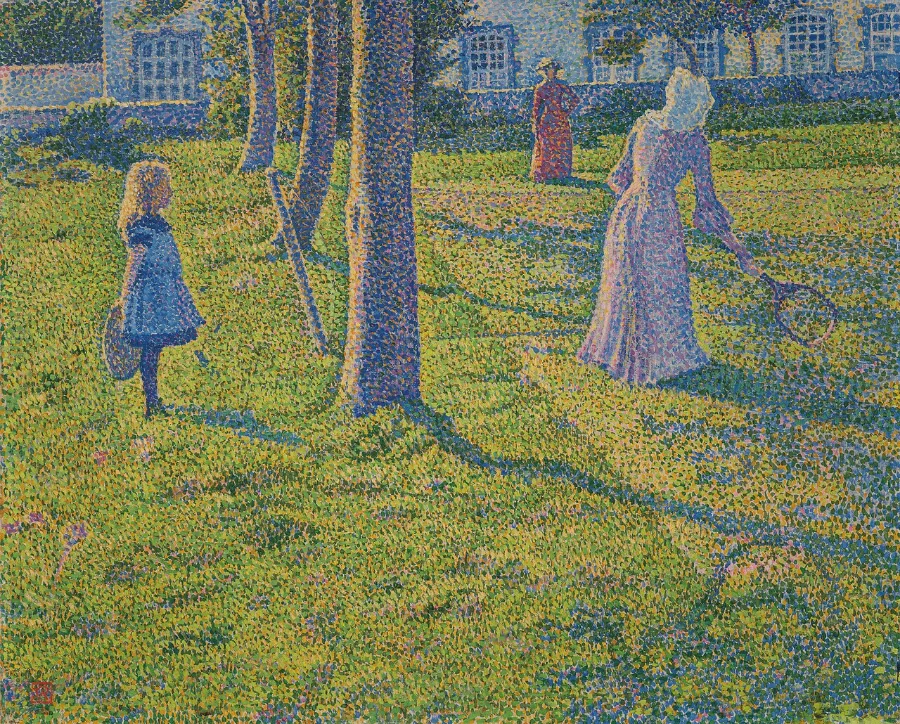
Theo van Rysselberghe was doing it in 1889, right at the start. Look at the grass: no part of it is one colour, and from across a room the whole lawn turns green anyway.
Three words that are not the same word
Neo-Impressionism
The name of the movement, which began in France in the 1880s. The critic Félix Fénéon proposed the term in 1886. What united the painters was a systematic interest in colour and in optical mixing.
Divisionism
The principle: instead of mixing shades fully on the palette, you lay them down separately, so they interact on the surface and in the viewer.
Pointillism
The technique: applying paint in small dots or short separate touches. From the French point — a dot.
Worth knowing. These three words are often used side by side, but they are not interchangeable. Neo-Impressionism is a movement, divisionism is a principle, pointillism is a way of putting paint on.
How colour mixes in your eyes
Imagine two patches.
On the first, the painter mixed red and yellow paint and got a finished orange. On the second, they placed red dots and yellow dots next to each other.
From a distance the second patch also looks orange — but inside it the separate reds and yellows go on flickering. That is why the colour looks more alive.
Pairs that strengthen each other
Blue and orange. Red and green. Yellow and violet. These are called complementary colours, and placed side by side they make each other look brighter.
Fact card. This is not a magic formula and not the same as a modern screen made of pixels. The result depends on the pigments, the size of the marks, the light in the room and how far away you stand.
The painting did not change. What changed is the way you looked at it.
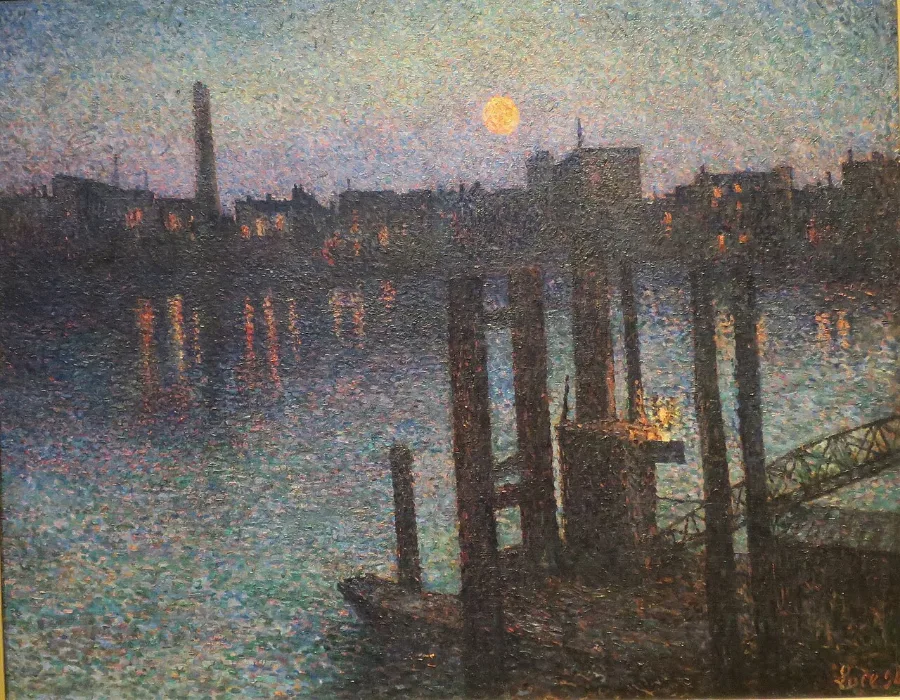
It works in the dark too, which is the harder trick. Maximilien Luce painted the Thames at night entirely in separate dots — and the water still glows.
Why they did not mix it all beforehand
A mixed colour usually becomes calmer and darker. Separate, pure touches keep the differences between colours alive, and can create a feeling of light, air and a vibrating surface.
A pointillist is not simply poking at the canvas. They are deciding:
- how big the dots will be;
- how densely they sit;
- which colours end up as neighbours;
- where the eye should read light, shadow and form;
- from what distance the picture is meant to come together.
Observation. Very slow, very exact work, in the service of showing instantaneous light. Nobody said painters had to be reasonable.
Looking closely at our capybara
Press the numbers to find what the dots are doing.
Pick a number
Each marker points at one thing this movement cared about.
Observation. The style changed completely. The animal did not: barrel body, short legs, blunt rectangular muzzle, small round ears, almost no tail. She is still a capybara.
The painters who assembled the world in pieces
Georges Seurat — the architect of colour
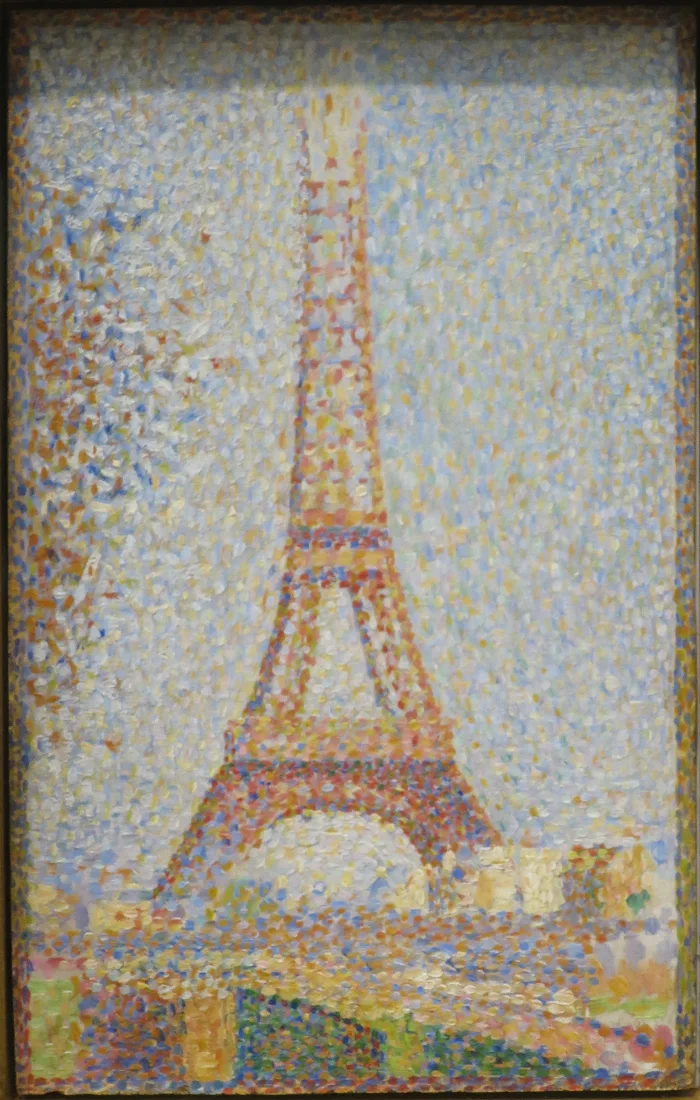
Planned his compositions carefully and studied how shades behave together. In the large painting A Sunday on La Grande Jatte the figures and the landscape are built from a multitude of separate colour touches. His preparatory drawings, by contrast, are almost without colour at all — proof of how seriously he worked at light, shade and form first.
a calm, carefully calculated pose, and every dot exactly where it was meant to go.
Paul Signac — colour in motion
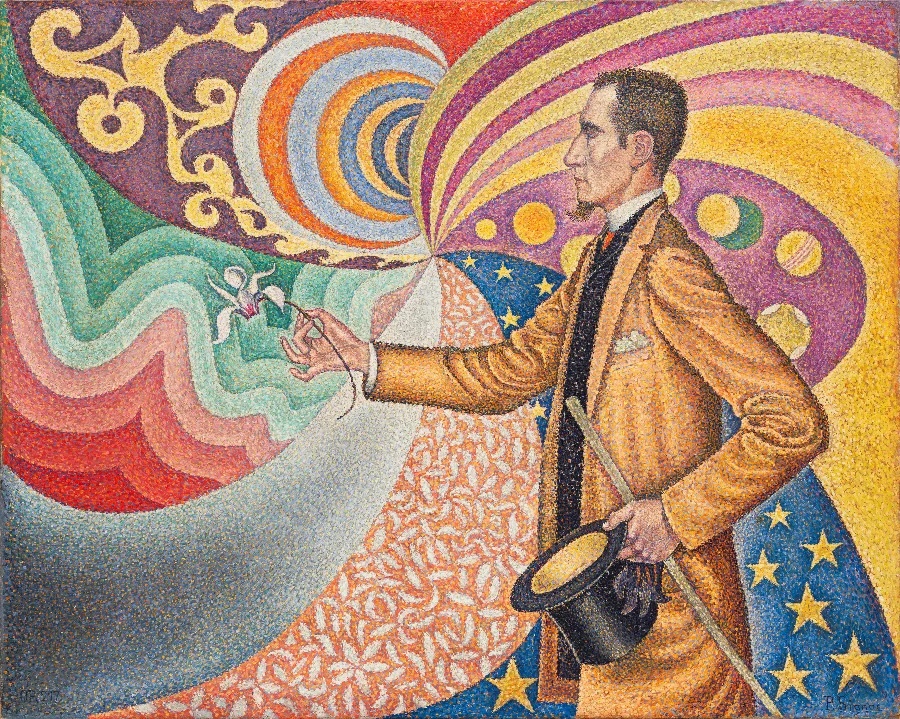
Signac loved the sea, harbours and sailing boats. Over time his marks grew larger, more like small coloured mosaic tiles. He also wrote a great deal, and helped spread the ideas of Neo-Impressionism.
reflections on the water, a sunny bank, and bigger, bolder pieces of colour.
Henri-Edmond Cross — the light of the Mediterranean
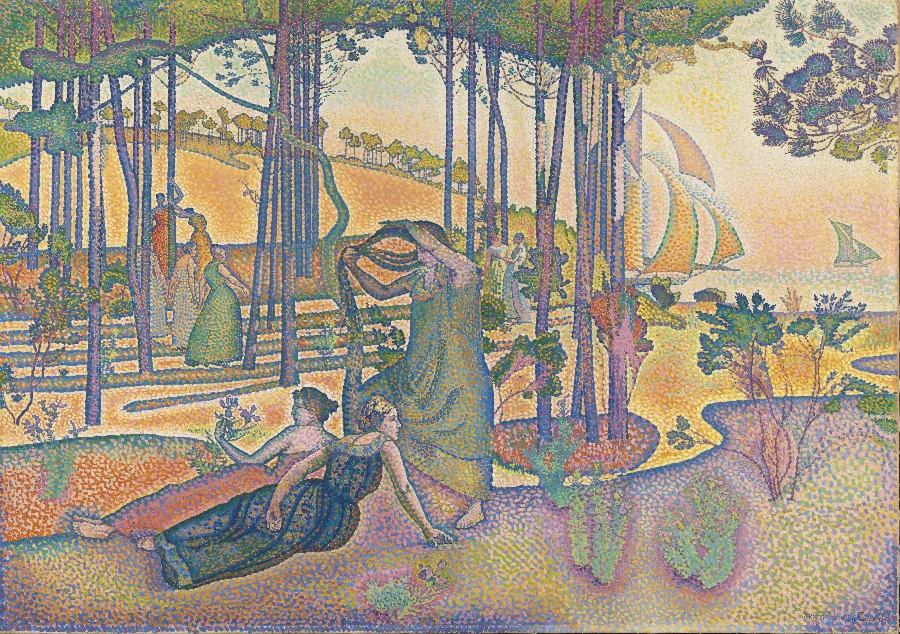
Cross made glowing landscapes of the south of France, where separate marks of colour add up to warm air, bright plants and pale water.
warmth, freedom, and colour mattering more than a strict outline.
Camille Pissarro — a short experiment
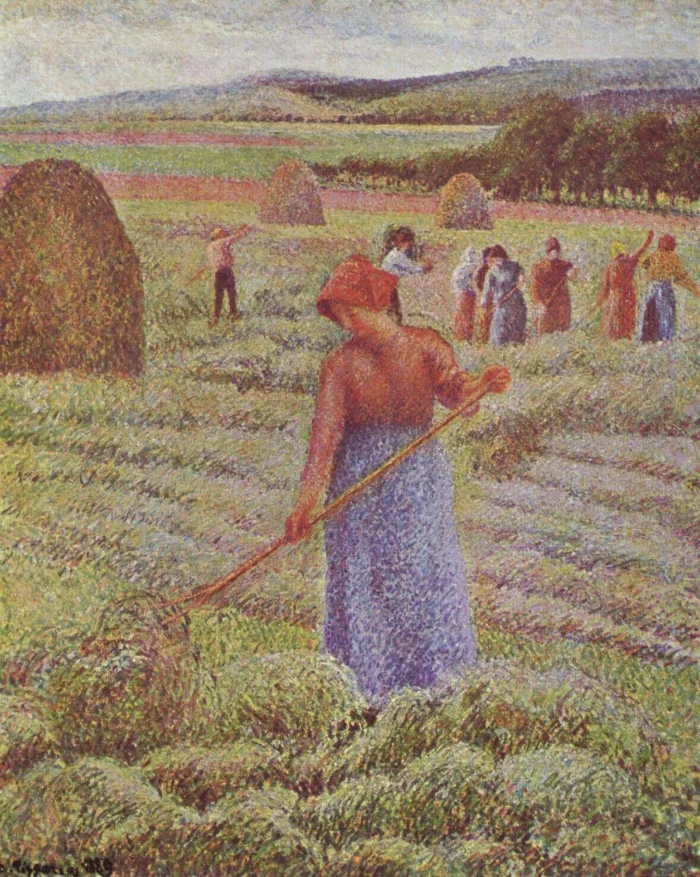
Pissarro turned to the Neo-Impressionist technique for a few years, trying a more systematic division of colour. Later he went back to his freer manner — which shows that a painter can change method and keep searching.
allowed to try a difficult technique, and then decide whether it suits her.
How motionless dots show movement
A dot on its own cannot move. But a run of dots can lead your eye, like footprints in sand.
In our picture the movement is made by the diagonal of the body, the lifted front paw, the arc of flying droplets, the long horizontal rows of dots on the water, and the way the marks are dense near her body and sparse further away.
Nothing in the picture moves. Your eye does the moving, and the painter decided where.
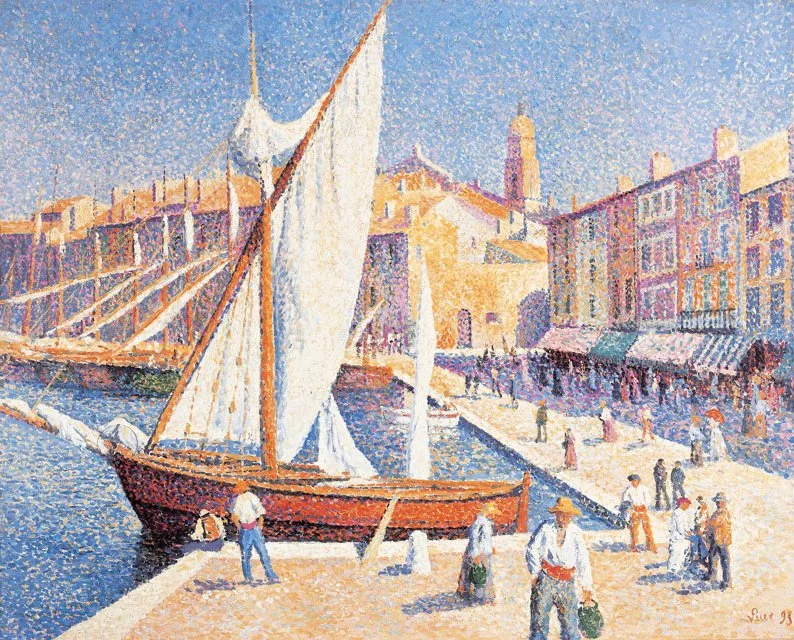
Luce again, this time in full sun. Follow the quay from the boat to the shops: the dots get smaller and closer together as things go further away, and that alone makes the harbour deep.
The colour lab
Three things to try, with paint and a room you can walk across.
One blue, two impressions
Paint the same blue square twice: once on an orange ground, once on a green one. The square is identical. Ask yourself where the blue looks brighter, and where colder. Nothing changed but the neighbours.
Build a third colour
Choose two paints. Cover a patch with separate dots of both, never touching. Walk backwards until a third colour appears that you never mixed.
Find the hidden capybara
Work very close to the paper, putting down dots without looking at the whole. Then stand up and step away. Things you did not draw will have appeared.
Fact card. If someone finds colours hard to tell apart, change the shape of the marks as well — circles, diamonds, short dashes. Then the pattern is readable without relying on colour at all.
The observer's glossary
Creative workshop: a capybara from eight hundred dots
Worth knowing. What you need: thick paper, gouache or acrylic, cotton buds, the blunt end of a pencil, or small round stamps.
- Lightly sketch a big capybara silhouette and the waterline.
- Choose one warm and one cool pair of colours.
- Start with the large areas: body, water, bank, sky.
- Do not fill them in solidly — build them from separate dots.
- Use cool neighbouring shades in the shadows and warm ones in the light.
- Add droplets around a raised paw to show the action.
- Look at your work up close. Then take three steps back.
Fact card. Choose the action first — stepping out, diving, turning her head, shaking off water — and then let the direction of the dots follow it.
Afterwards: what is easier to see up close, the separate colours or the capybara? And what changed when you stepped away?
What to keep
“Nothing here was ever mixed. You did the mixing, standing where you are.”
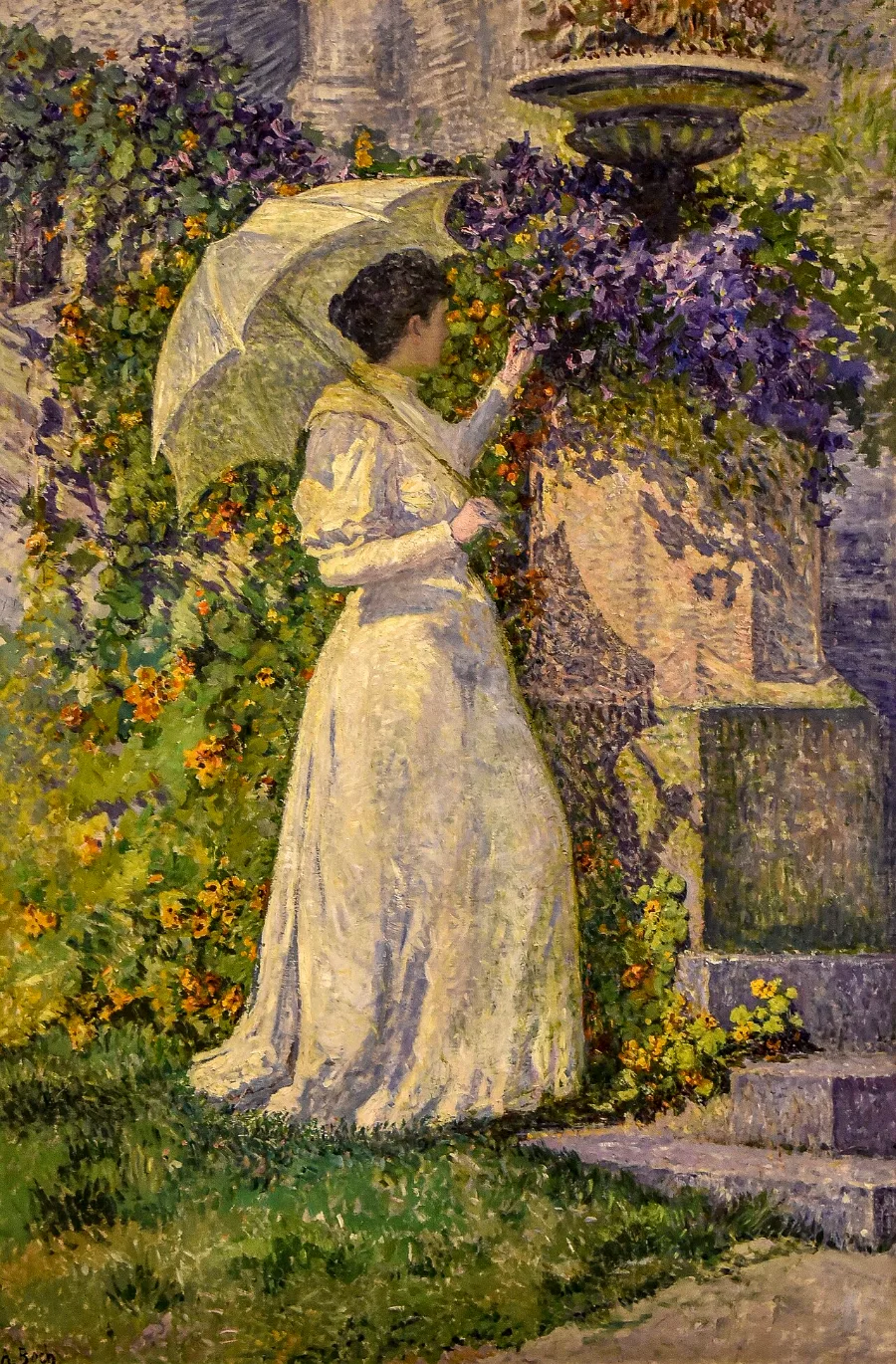
One last painter, and she is usually left out. Anna Boch was a Neo-Impressionist, and the only person known to have bought a painting from van Gogh while he was alive. This is her garden in June, 1894.
1. What does the word “pointillism” mean?
From the French point — a dot. It names the technique, not the whole movement.
2. Where does the main mixing of neighbouring colours happen?
Which is why the same picture is two different pictures depending on where you stand.
3. Why are Neo-Impressionism and pointillism not quite the same thing?
Divisionism is the principle in between: separating the colour at all.
4. Which two painters are the movement's best-known names?
Seurat worked it out; Signac carried it on and wrote it down.
5. What makes our capybara look as though she is moving?
Not one dot in the picture moves. The arrangement does the work.
6. Must every pointillist mark be a perfect circle?
What matters is that the colours stay separate and let the eye do the joining.