Abstract Expressionism
The capybara stands in front of a canvas so large it barely fits on the screen. A wide black line runs across a pale field, ochre drops fly beside it, and a deep red rectangle seems to be holding the whole thing together. There is no story here in the usual sense: the event of the picture is the gesture itself.
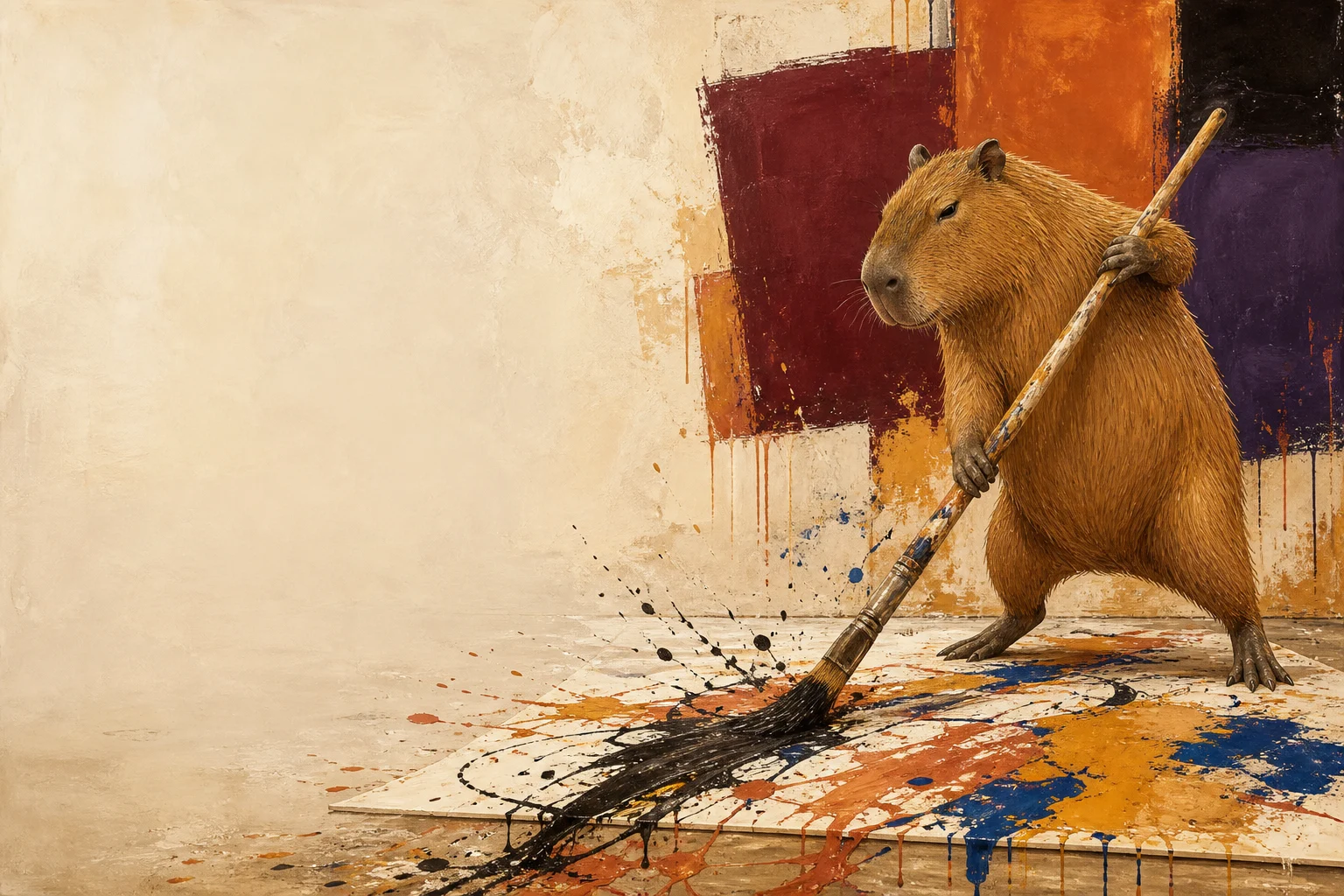
“I have not decided what it is yet. That is not a problem, it is the method.”
What Abstract Expressionism is
Abstract Expressionism began in the United States in the 1940s and became one of the first American movements in art to have worldwide influence. Its painters gave up any obligation to show recognisable objects and concentrated instead on colour, texture, scale — and on the process of making the painting.
The name gathers together very different artists. Some turned painting into an action: moving around the canvas, pouring and flinging paint. Others made large, quiet fields of colour in front of which a viewer could stop and sink into their own sensations.
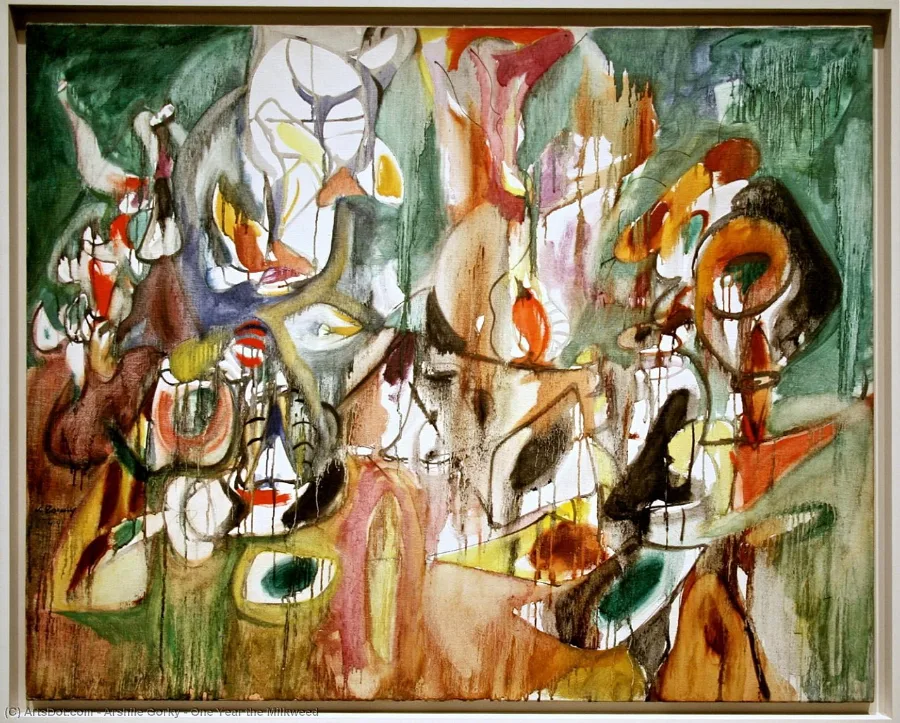
Arshile Gorky was one of the first, and he was gone before the movement had a name. He painted this in 1944. There is nothing in it you can point at and name, and it still looks like something alive and growing.
And this is Arthur Dove, painting in 1927. He was doing it before almost anyone in America, quietly, on a farm and later on a boat, while nobody much was looking.
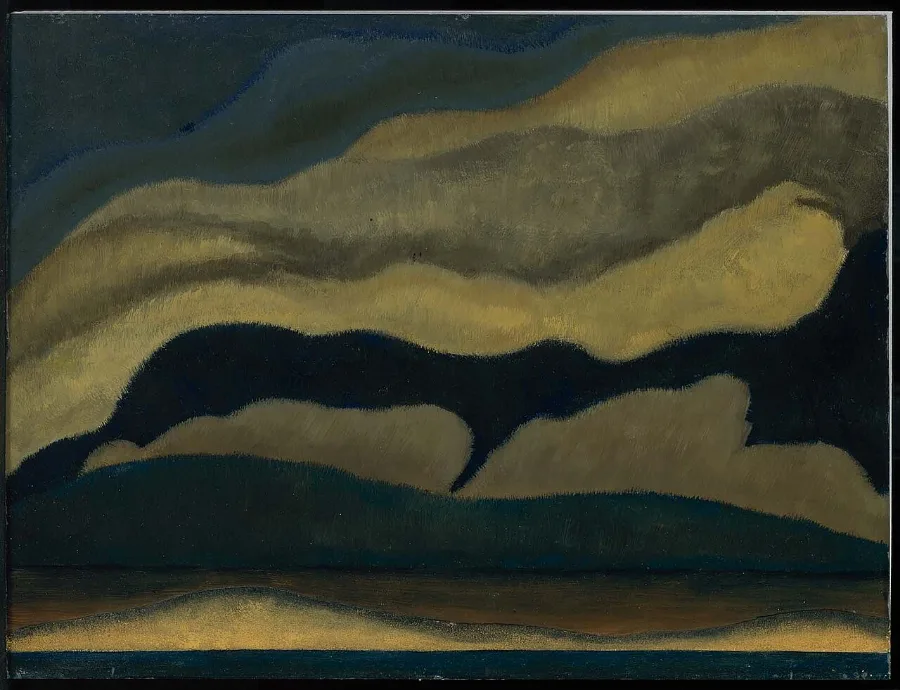
A capybara suits this movement unexpectedly well: outwardly calm, capable of one decisive mark, and then perfectly happy to sit and watch what the colour does to the room.
New York becomes the centre
After the Second World War, New York turned into the most important centre of modern art. Many European artists and thinkers arrived in the city, and young American painters had a chance to meet Cubism, Surrealism and the idea of artistic automatism at first hand.
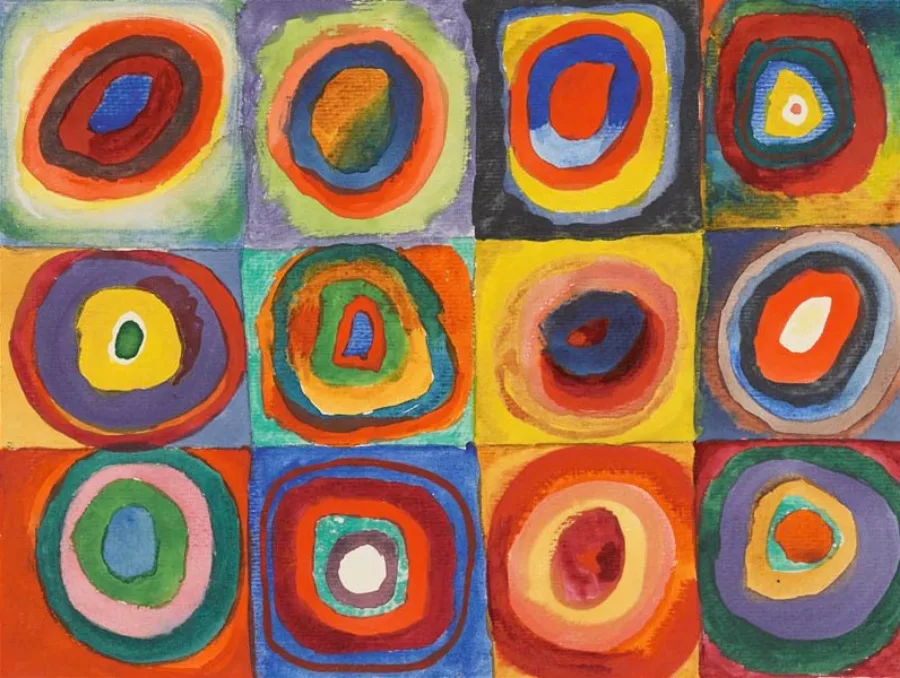
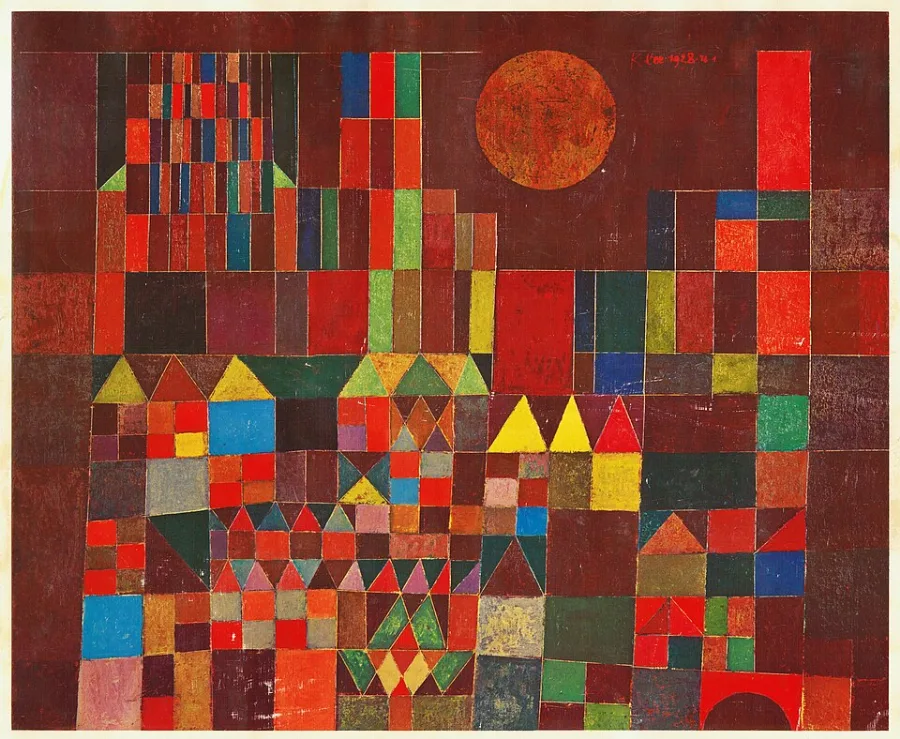
These two are what arrived with them. Kandinsky had stopped painting objects thirty years earlier and painted colours doing things to each other instead; Klee built pictures out of small coloured squares that you may read as a castle or as nothing at all.
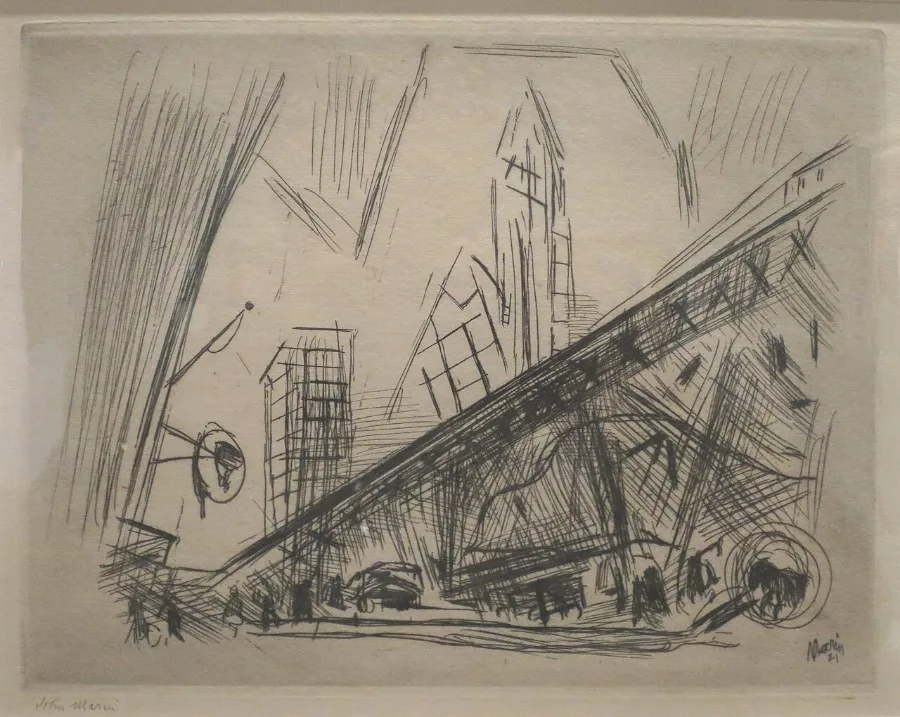
John Marin was drawing New York like this in 1921, long before it became the centre of anything. The towers lean, the railway cuts across the middle, and the whole city looks as though somebody has shaken it.
The Abstract Expressionists worked independently of one another, but they shared a wish to start again. The large format meant you no longer simply looked at a picture — you almost entered it. The canvas stopped being a window onto a depicted world and became a space in its own right, where the painter's gesture and the viewer meet.
Two roads: action and colour field
Action painting
Keeps the trace of a physical movement. A drip, a swing, the pressure of a brush and a pause all become part of the image. The picture reads as the record of an event that happened on the canvas.
Colour field painting
Is built from large areas of colour and the fine relationships between them. There are fewer visible gestures; what matters is size, glow, soft edges, and the time a viewer spends in front of the work.
Worth knowing. Both talk about experience rather than about objects. One works quickly and loudly, the other slowly and almost in silence.
Looking closely at our scene
Press the numbers.
Pick a number
Each marker points at one thing this movement cared about.
Observation. The painter is working with her whole body, not just her hand. The picture is a record of where she stood.
Jackson Pollock and action painting
Pollock became famous for a technique in which the canvas was laid on the floor and paint was poured, dripped and flung from every side. It let him move inside the working space and tie the drawing to the rhythm of his body.
Pollock was not simply scattering paint at random. He varied the density of the lines, the distance from the surface, the direction of movement and the pauses between layers. The result is a complex net in which the eye can travel with no single centre.
Fact card. The quickest way to see the control in a Pollock is to look for where a line stops. Accidents do not stop; decisions do.
Worth knowing. There is no Pollock on this page and no Rothko either, and for once the reason has a date on it. A painting stays in copyright for seventy years after the artist dies. Pollock died in 1956, so his work becomes free here on 1 January 2027 — a few months after this chapter was written. Rothko died in 1970, so his are protected until 2041. What we can show is Gorky and Tomlin, who were in the same rooms and died earlier.
Mark Rothko and the force of a colour field
Rothko made paintings from large zones of colour with soft, almost breathing borders. Their effect is very hard to convey in a small reproduction: he was counting on a viewer standing close, and staying a while.
For Rothko colour is not the covering of an object. The neighbouring of a deep red, a coral, a dark brown or a pale tone can bring on calm, tension, warmth or a sense of loss.
Some paintings ask for a glance. These ask for your time, which is a much bigger request.
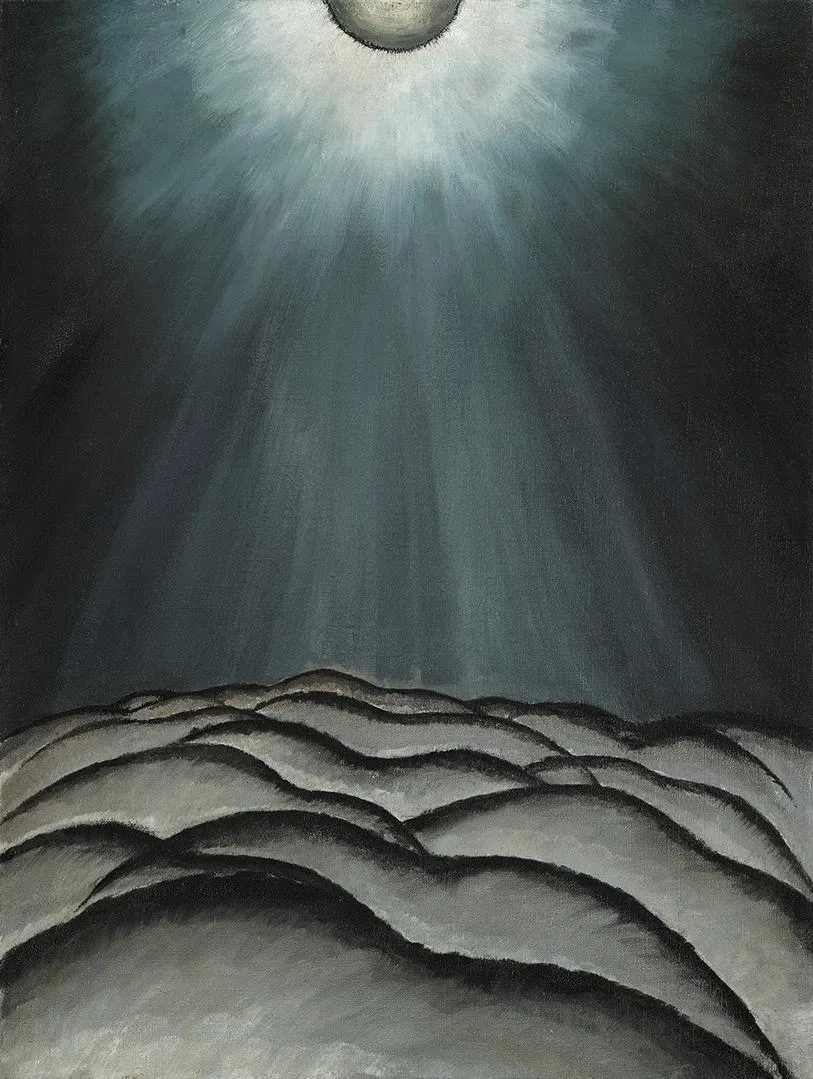
Dove again, thirty years before Rothko. There is a moon and there is water, and almost nothing else is described — you are being asked to look at a glow, not at a place.
The vocabulary of the movement
How to spot an Abstract Expressionist work
A large format, and the feeling that the picture continues past its own edges. No obligatory subject or recognisable object. A visible gesture — runs, sweeps, scratches, splashes. Colour acting on you emotionally. Attention to process, material and texture. And a composition with no single main character in it.
Worth knowing. Both roads share those last three. If you can name where the paint was thin and where it pooled, you are already reading the picture the way it wants to be read.
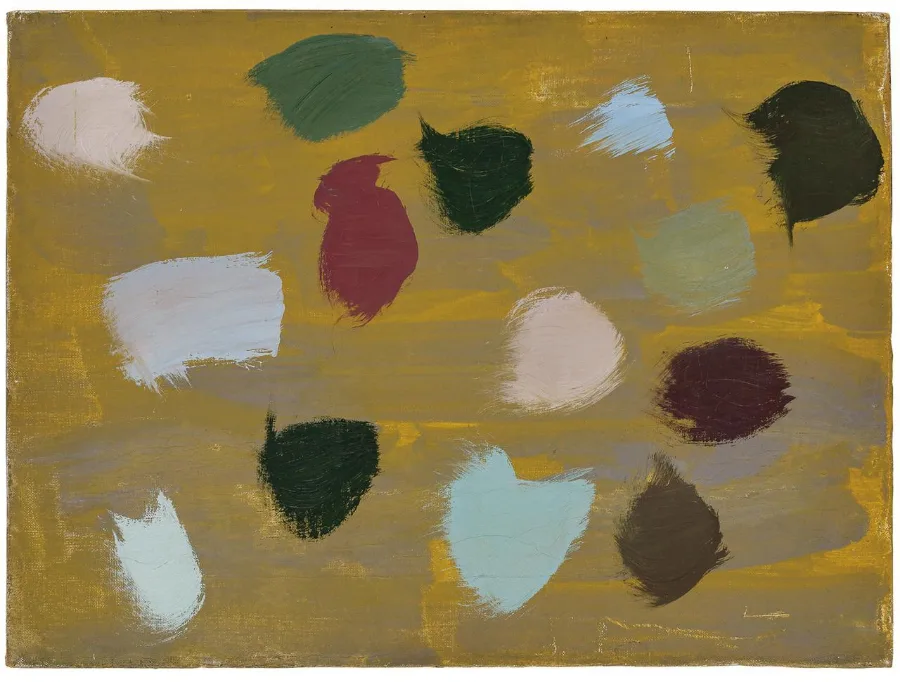
Try it on this one. Bradley Walker Tomlin painted it at the very end of his life, and every mark in it was made in a single movement — you can see where the brush was loaded and where it ran dry.
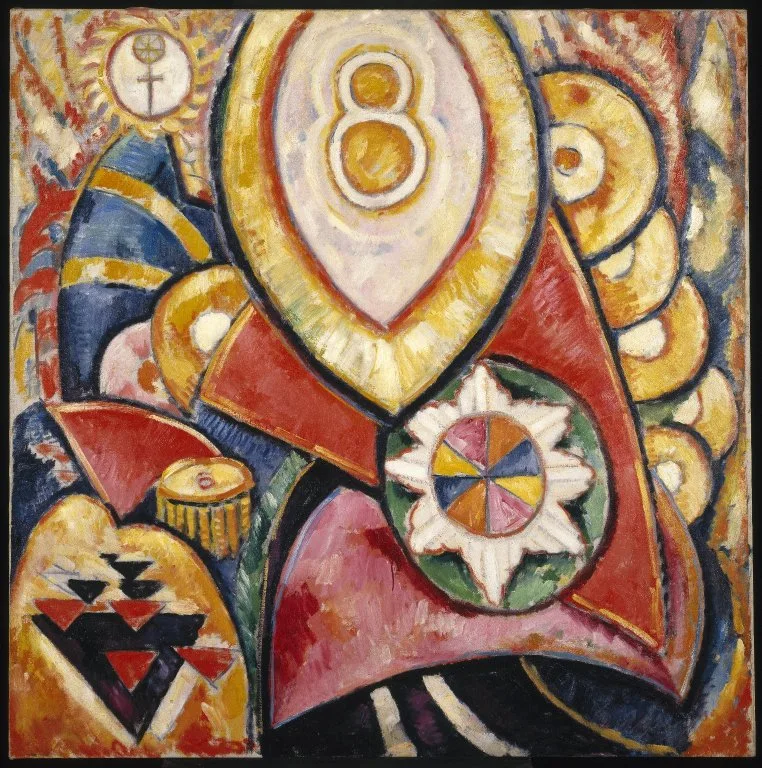
And one more, from 1913. Marsden Hartley had been to Germany and come back with pictures like this: no subject you can name, colour doing all the work, and a shape in the middle that looks like a flag for a country that does not exist.
Gesture or field?
Two things to try, and they answer different questions.
Try a gesture
Take the longest brush you can hold and make one line across a big sheet, moving from the shoulder. Do it three times at three different speeds. Look at what the speed did to the width.
Try a field
Cover two large areas with flat colour and spend a long time only on the border between them: hard, then soft, then almost dissolved. Choose a word for each version — calm, tension, warmth, space.
Fact card. There is no good and bad result here. What the exercise reports back is which decisions you made: fast or slow rhythm, sharp or soft contrast, crowded or open.
Creative workshop: a map of the capybara's movement
Worth knowing. What you need: a big sheet, water-based paint, a wide brush and a thin one, a sponge, and something to protect the floor.
- Choose one state: energy, quiet, curiosity or unease.
- Plan a route of movement around the sheet, like a capybara's path.
- Make one long gesture using the whole forearm.
- Add a series of short rhythmic marks.
- Make a calm field of colour that either argues with the gesture or supports it.
- Step back several paces and decide whether one more layer is needed.
The task is not to copy a particular painter but to find out how movement, pause and colour can themselves be the content of a picture.
What to keep
“No subject, no story, no hero. Just the size of the canvas, the speed of an arm, and how long you are willing to stand there.”
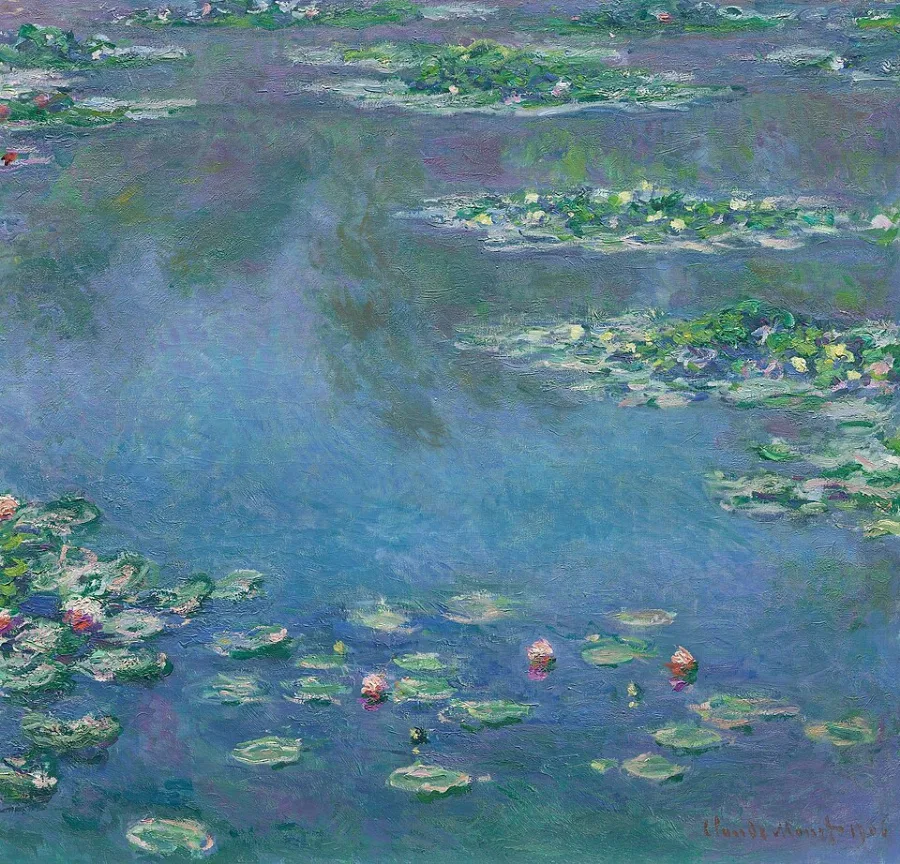
One last thing, and it runs backwards. When these painters were working, the late water lilies Monet had made forty years earlier were being looked at again, and suddenly they made a different kind of sense: no horizon, no story, a surface you stand in front of rather than look through. The first chapter of this series ends up being the last one too.
Our capybara puts the brush down. One chapter left, and in it a group of painters decide that children and animals had the right idea all along.
1. Where did Abstract Expressionism become especially influential in the 1940s?
New York became the centre of modern art after the Second World War.
2. What matters most in action painting?
The picture reads as the record of an event, not a description of a thing.
3. What does “colour field” mean?
Fewer gestures, more time — a different road to the same aim.
4. Why did many of these painters use very large canvases?
At that size you no longer look at a painting. You stand inside its reach.
5. How did Jackson Pollock usually work?
Which is why his pictures have no single right way up while being made.
6. Was Pollock simply throwing paint at random?
Look for where a line stops. Accidents do not stop.