Cubism
Everything in the studio has started moving. The capybara reaches for a pear, the jug turns sideways, the table seems to be assembled out of separate cards, and the whole scene is showing us several moments at the same time.
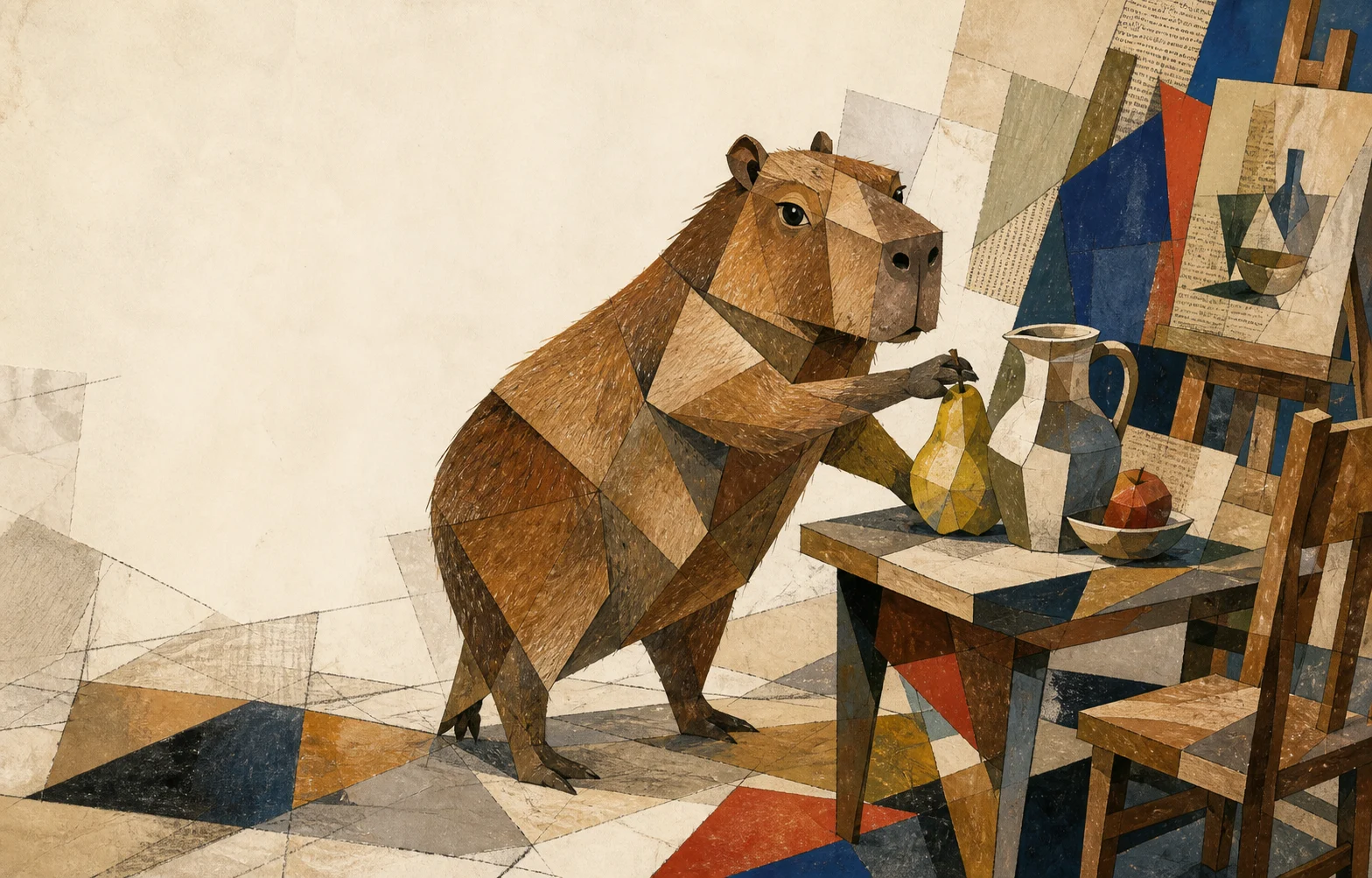
“I can see the pear from both sides. I still cannot reach it.”
What the Cubists changed
Before the twentieth century, European painting often worked to build a convincing illusion of depth: far things got smaller, volume was made with light and shade, and the viewer was given one steady place to stand in front of the picture.
The Cubists asked a different question. Why should a painting show only what is visible in one second? When we look at a jug we can walk round it, look in from above, remember the handle and the spout. On a canvas all those observations can be put together.
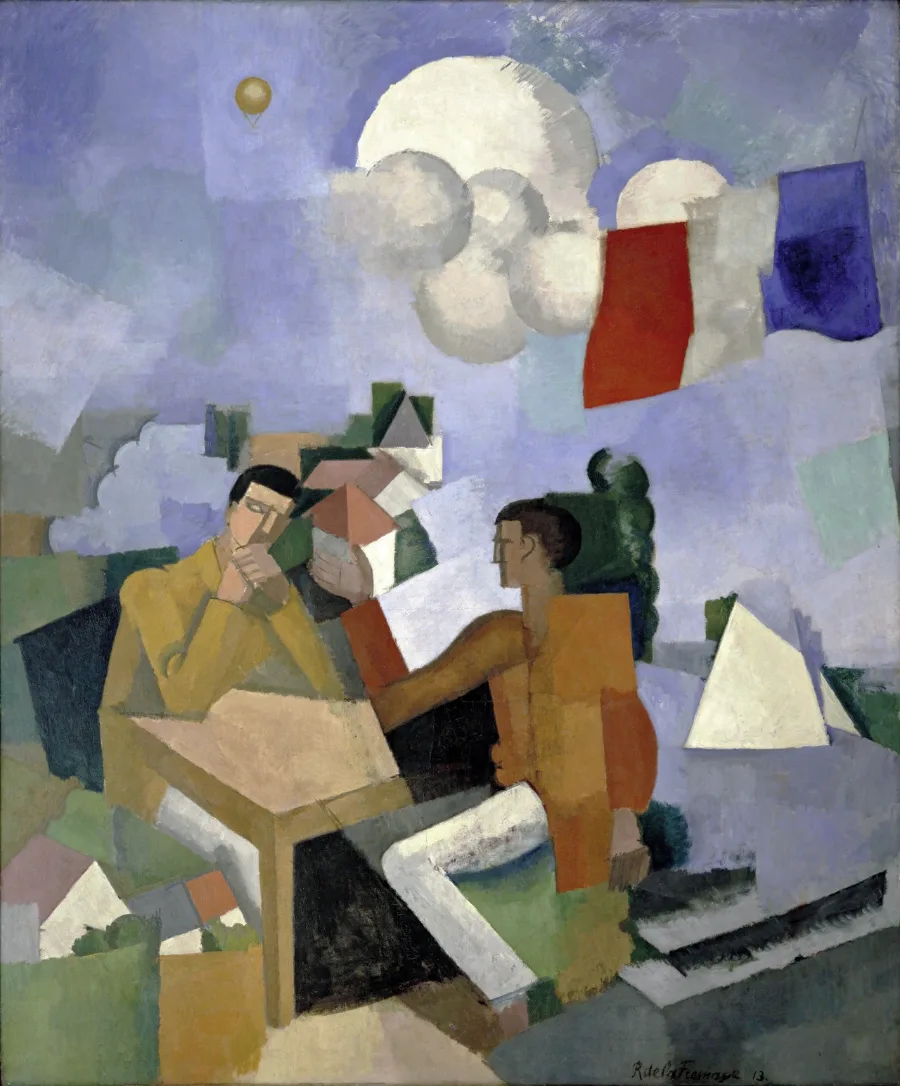
Here is one. Roger de La Fresnaye painted two men at a table in the open air, with a balloon, a sail and a small aeroplane above them. Look at what he has done: the men, the table, the water and the sky are all built from the same flat planes, so the picture feels assembled rather than photographed.
Fact card. Cubism is not a rule that says “draw everything square”. Its real discovery was to take the familiar look of an object apart and build the picture again from scratch.
The Paris laboratory
Cubism appeared in Paris in the first years of the twentieth century. Between 1907 and 1914 Georges Braque and Pablo Picasso worked in close conversation: looking at one another's canvases, arguing about decisions, and changing the language of painting step by step.
They were influenced by Paul Cézanne, who had looked for steady volumes and construction in nature. In 1908 the critic Louis Vauxcelles saw new work by Braque and spoke dismissively of “cubes”. The mocking word stuck, although the movement turned out to be far more complicated than its name.
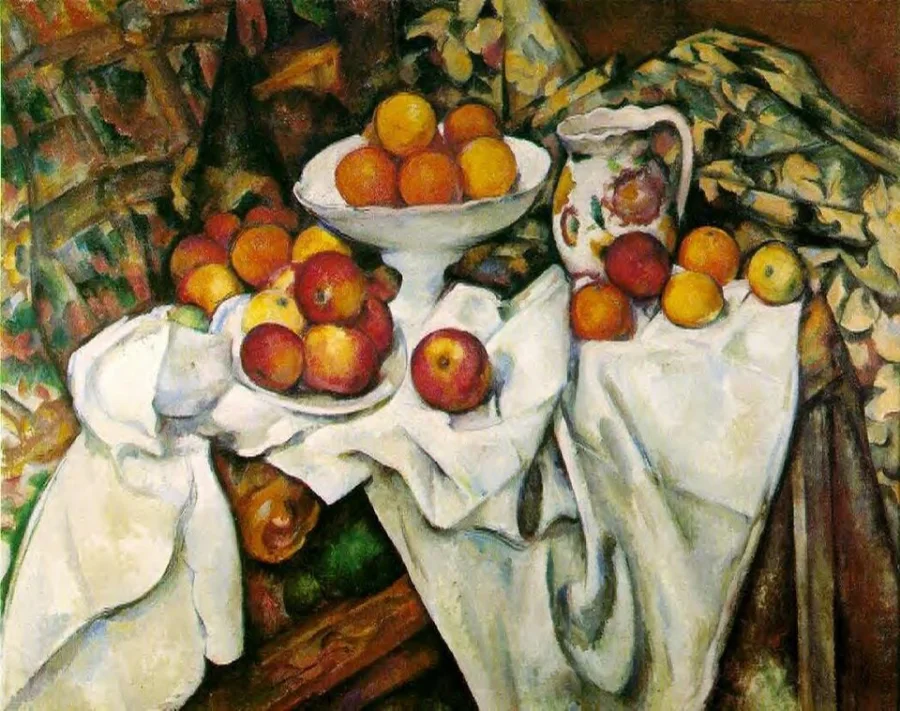
Cézanne's own still lifes are the place to start. The dish, the jug and the table in this one are each seen from a slightly different angle — the idea the Cubists took and pushed a great deal further.
Cubism was not made in a day, and not by one person. It grew out of collaboration, disagreement and a great many attempts.
One object, several meetings
Look at the capybara. Her long blunt muzzle is somehow seen in profile and from the front at the same time. One eye follows the pear; the other seems to be looking at us. Her shoulder faces one way and her short legs face several.
This is how the Cubists showed not a photographic instant but the experience of looking. The picture holds several meetings with the object: here we noticed the edge of the table, here we looked into the jug, here we walked round the figure.
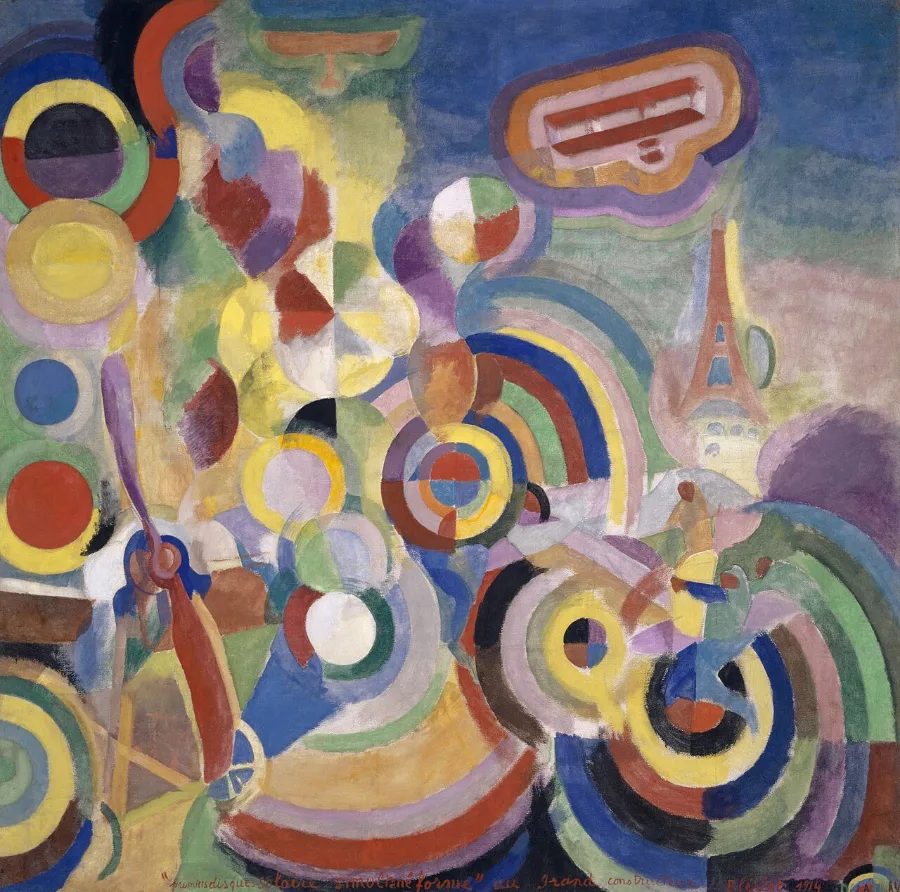
Robert Delaunay took the idea to something that never holds still. Instead of one propeller blade in one correct place, his canvas is full of coloured discs — nearer to what a turning propeller actually does to your eye.
Looking closely at our illustration
Press the numbers to see what is taken apart, and what is deliberately left whole.
Pick a number
Each marker points at one thing this movement cared about.
Observation. Small round ears, blunt muzzle, heavy body, short legs, no long tail. The style may take her apart, but the anatomy is never negotiable.
Analytic Cubism
From about 1910, Braque and Picasso broke objects into many small planes. Space became shallow, forms seemed to pass through one another, and the palette was often limited to browns, greys, blacks and ochres.
This stage is called analytic Cubism: the painter examines the object, takes it apart into visual clues, and invites the viewer to put the whole back together.
Albert Gleizes painted a man standing on a balcony exactly this way in 1912. His head, one hand and his jacket stay recognisable; the balcony rail and the city behind slide straight through him.
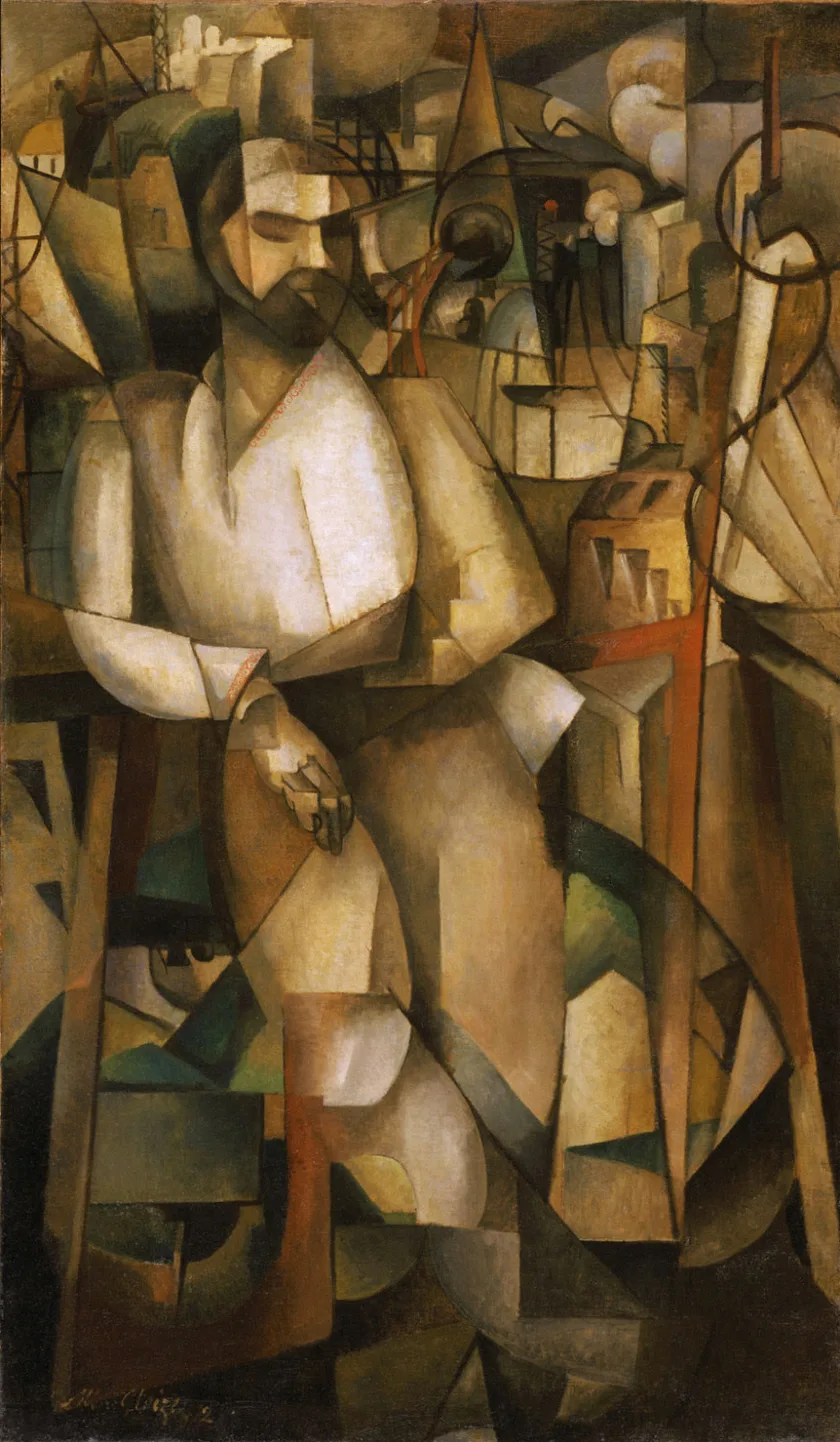
Worth knowing. The colours were cut back on purpose. With less colour to distract you, the structure of the picture is easier to read — which was exactly what they wanted you to look at.
Synthetic Cubism
Around 1912 the pictures grew simpler, more contrasted and brighter. Large shapes appeared, along with printed letters and real pieces of daily life: newspaper, wallpaper, a label, wrapping paper.
Braque began using papier collé — glued paper fragments. Now the painter was not only taking an object apart but synthesising it: assembling it from different materials.
Juan Gris built this still life the same way. Some shapes are painted plainly and some are patterned like wallpaper, and they overlap exactly as pieces of cut and pasted paper would.
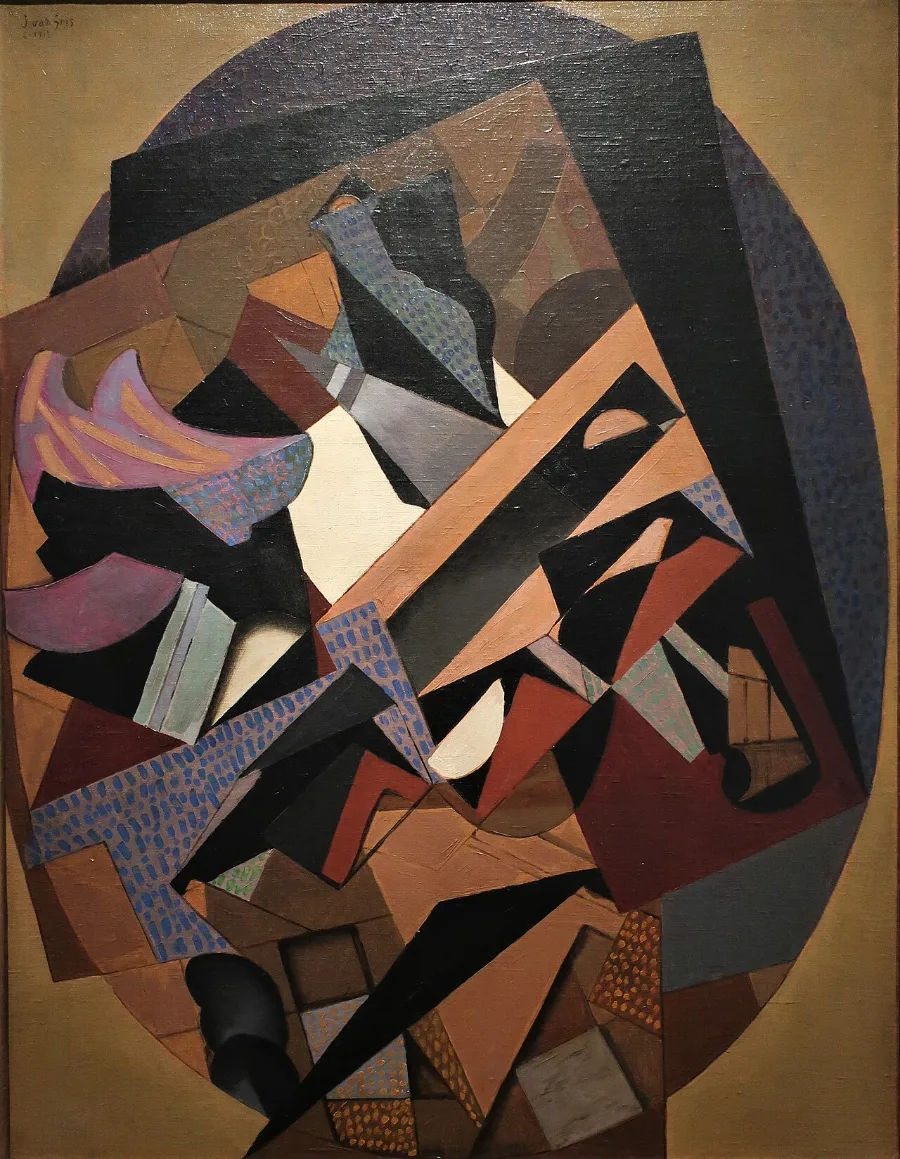
Analytic takes apart. Synthetic puts together, out of whatever is to hand. The same curiosity, running in two directions.
Picasso and Braque: a conversation in brushes
The two worked so closely that some of their Cubist paintings from this period are hard to tell apart without a signature. They were drawn to violins, guitars, bottles, glasses, playing cards, newspapers and faces — things that can be broken down into characteristic curves, holes, lines and lettering.
In our scene the musical instrument has been replaced by the quiet clutter of a studio: the handle of the jug plays the part of the recognisable curve, the table sets a rhythm of straight lines, and the pear becomes a bright sign among the planes.
Worth knowing. You will not find a painting by Picasso or Braque anywhere in this chapter, and that is not an oversight. A painting stays in copyright for seventy years after the painter dies, so theirs may not be shown on a website like this one until 2034 and 2044. What we can show is Picasso himself, painted in 1912 by their friend Juan Gris — in the language the three of them were working out together.
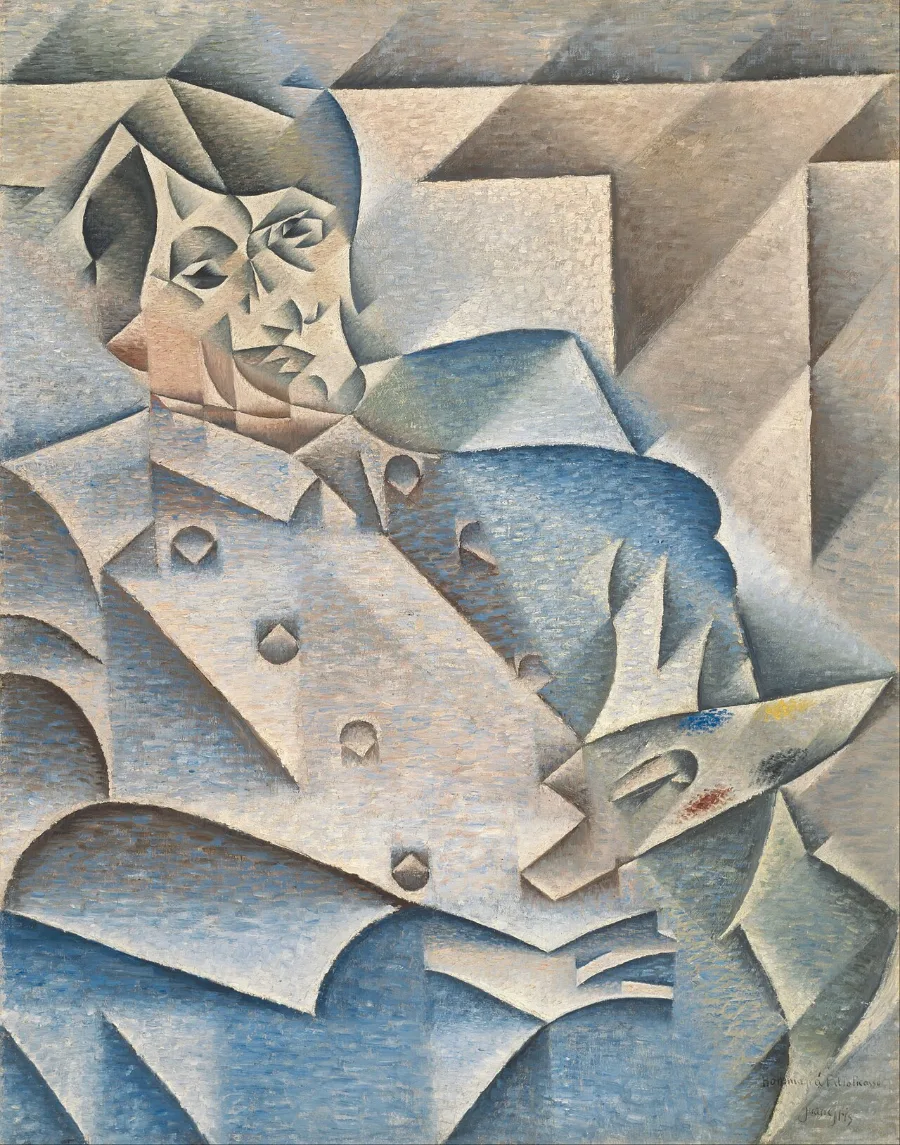
Fact card. Try naming the three details by which you still recognise an object once its outline has been broken. That short list is exactly what a Cubist keeps.
Gris and Léger: different Cubisms
Juan Gris
Made Cubist compositions clearer and more carefully organised. His shapes often look clean, and his colour relationships considered, almost decorative.
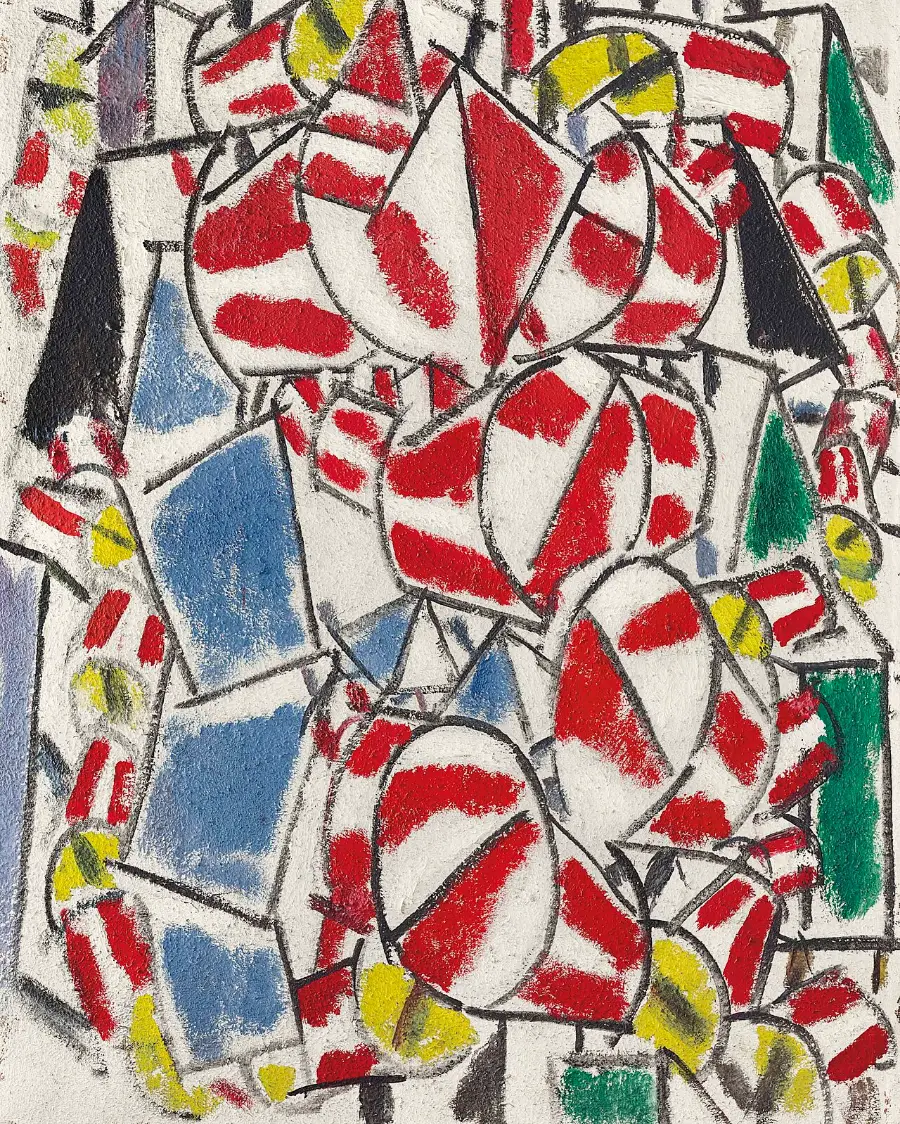
Fernand Léger
Took another road: powerful rounded volumes, strong contrasts and forms that recall the parts of a machine. Beside his painting, a capybara might become a heavy construction of cylinders and pipes — and still be good-natured about it.
Where the ideas came from, and what that costs
The Cubists learned from Cézanne, looked at ancient Iberian art, and studied sculpture from Africa and Oceania. Many of those objects had arrived in European museums through colonial seizure and trade, and the painters often borrowed their forms without naming the makers or explaining what the works had originally meant.
It is worth saying this plainly: an artistic influence does not cancel the history of the people and cultures the ideas were taken from. Both facts belong in the same sentence.
Creative workshop: build a capybara from planes
Worth knowing. What you need: kraft paper, old packaging without recognisable logos, coloured sheets, a pencil, glue and round-ended scissors.
- Draw a large barrel-shaped body and a blunt rectangular muzzle.
- Cut the drawing into 8–12 simple planes.
- Turn some of the pieces — but keep the small round ears and the short legs.
- Add an object seen from two sides at once: a cup from above and from the side, or a fruit whole and cut open.
- Glue in one texture, and draw a few lines over it with charcoal or a soft pencil.
- Check the result: a new composition, not a copy of a particular work by Picasso, Braque or anyone else.
The hard part is not breaking the shape. It is deciding how little you can leave and still be understood.
What to keep
“Cubism taught painters to see a picture not as a copy of the world but as a construction in its own right. Collage, abstraction and a great deal of the twentieth century grew out of those cut-up forms.”
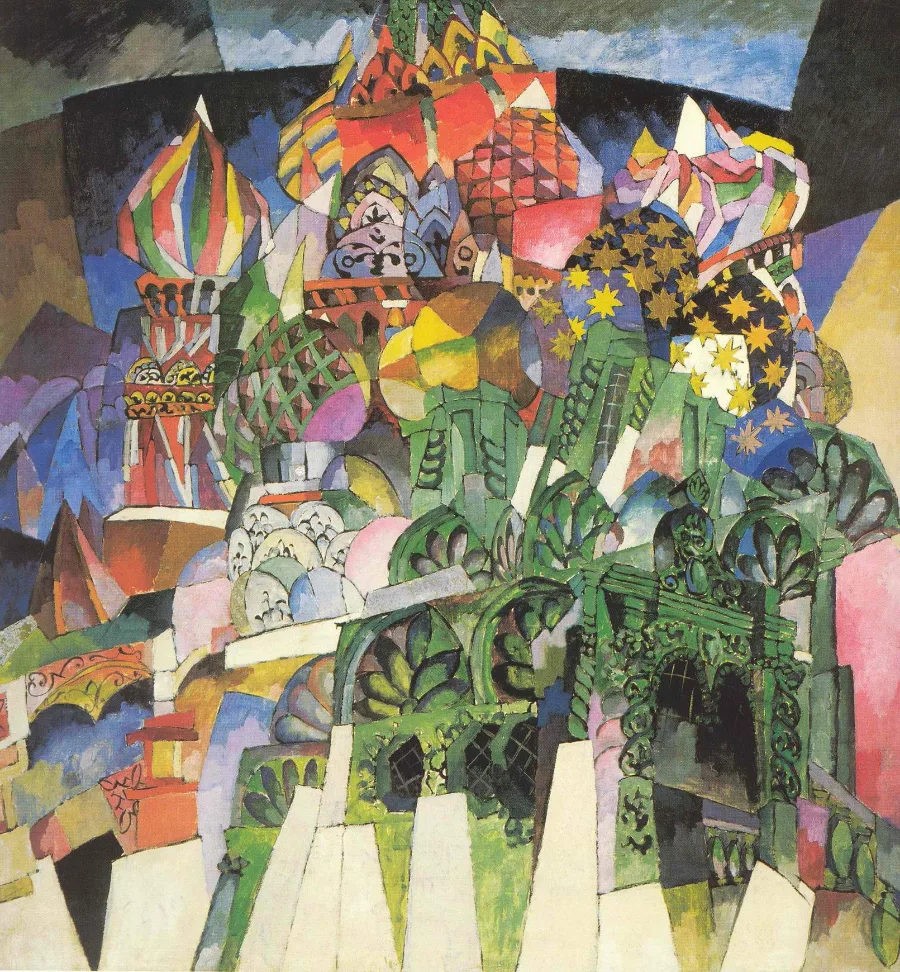
The idea travelled fast. In Moscow, a year or two later, Aristarkh Lentulov painted Saint Basil's Cathedral as a mosaic of sliding domes and hot colour — Cubism's way of building a picture, used on a building nobody in Paris had in mind.
Our capybara leaves the pear on the table and moves on. In the next chapter she meets an art that doubts not only the rules of picture-making but the whole solemn idea of “a work of art”.
1. What makes a picture Cubist?
The cubes were a critic's joke. The real subject is how an object is put together.
2. Which painter's search helped lead towards Cubism?
Cézanne looked for steady volumes and construction under the surface of nature.
3. What is different about analytic Cubism?
Less colour, so the structure is easier to read.
4. What did Braque add with papier collé?
Newspaper, wallpaper, a label: everyday material becoming part of the art.
5. Why did Picasso and Braque paint bottles, guitars and newspapers so often?
Familiar objects made it possible to take a shape apart and still be understood.
6. How should we talk about where the Cubists took their ideas from?
Both facts are true, and leaving one out makes the other misleading.