Surrealism
A lagoon at dusk looks almost ordinary — but only for the first few seconds. The capybara swims calmly across the water while her reflection sits on the bank. A bowler hat floats above the reeds, oranges rise into the sky, and a door standing in the middle of the water opens straight onto a desert.
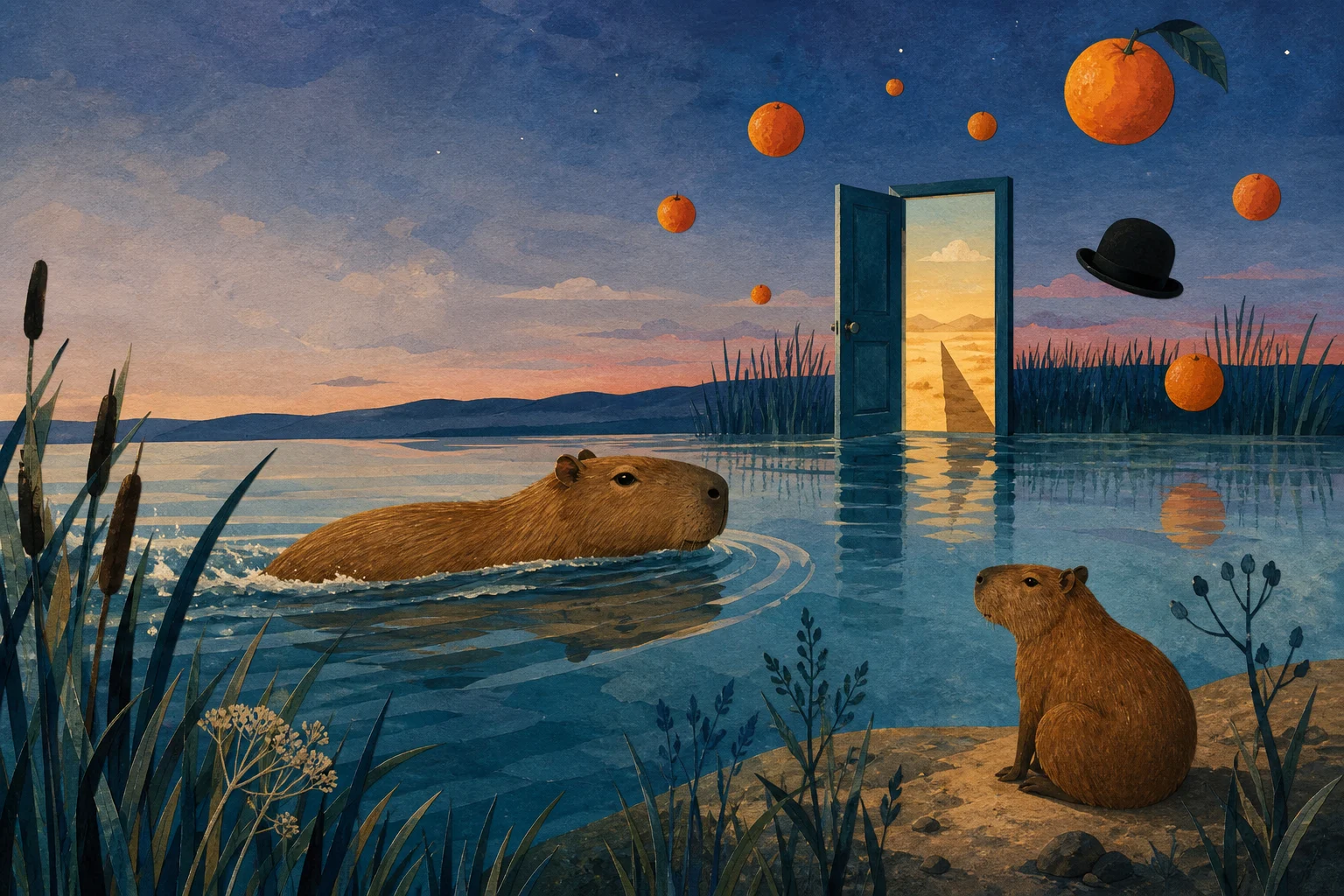
“Welcome to the place where the impossible behaves perfectly naturally.”
What Surrealism is
Surrealism appeared in Europe in the 1920s. Its artists wanted to free the imagination from everyday logic and to turn instead to dreams, chance associations, and the workings of the unconscious mind.
A Surrealist painting can be executed very precisely, almost photographically, while joining together things that do not belong side by side. Or it can be built from free signs and invented creatures. The point is not nonsense but a different logic — the logic of a dream.
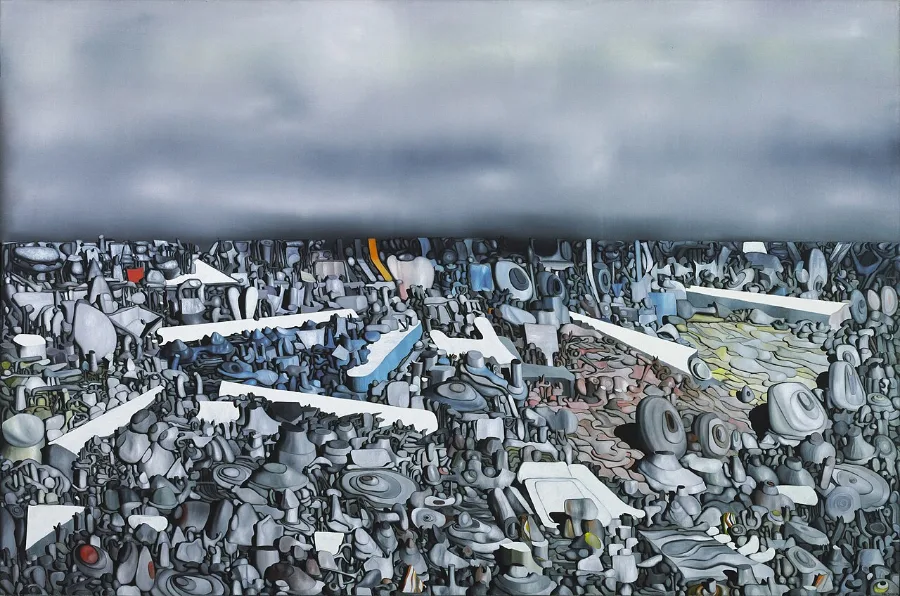
Yves Tanguy painted this plain in 1954. Nothing on it has a name. You cannot say what any of the objects are, and you still feel, immediately, that it is a place with weather and distance and a horizon — which is exactly the trick a dream plays.
From Dada to a manifesto
After the First World War the Dadaists rejected the accepted rules of art. The Surrealists inherited their nerve but turned it inward, towards human consciousness.
In 1924 the writer André Breton published the first Manifesto of Surrealism. In it he described automatism: a way of making a text or an image by letting thoughts and movements arrive without the strict control of the reasoning mind.
The capybara approves of the method. Sometimes the best route is found exactly when you stop demanding that the map explain itself.
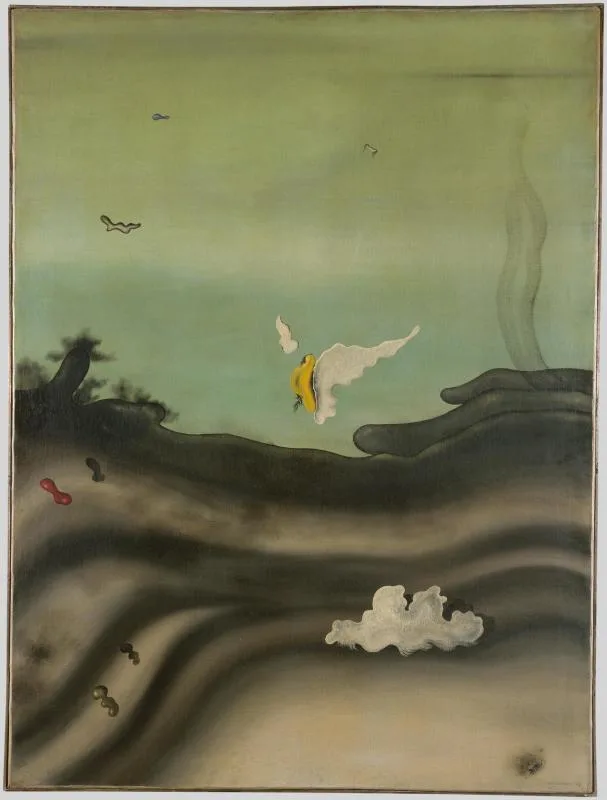
Tanguy joined the group in its first years, and this is from 1929, five years after the manifesto. The sky is green, the ground rolls like water, and the small bright thing in the middle is the only warm colour for miles.
The logic of a dream
In a dream we are rarely surprised by the impossible. A staircase can lead into a cloud, a small fruit can block the whole horizon, a shadow can live separately from its owner.
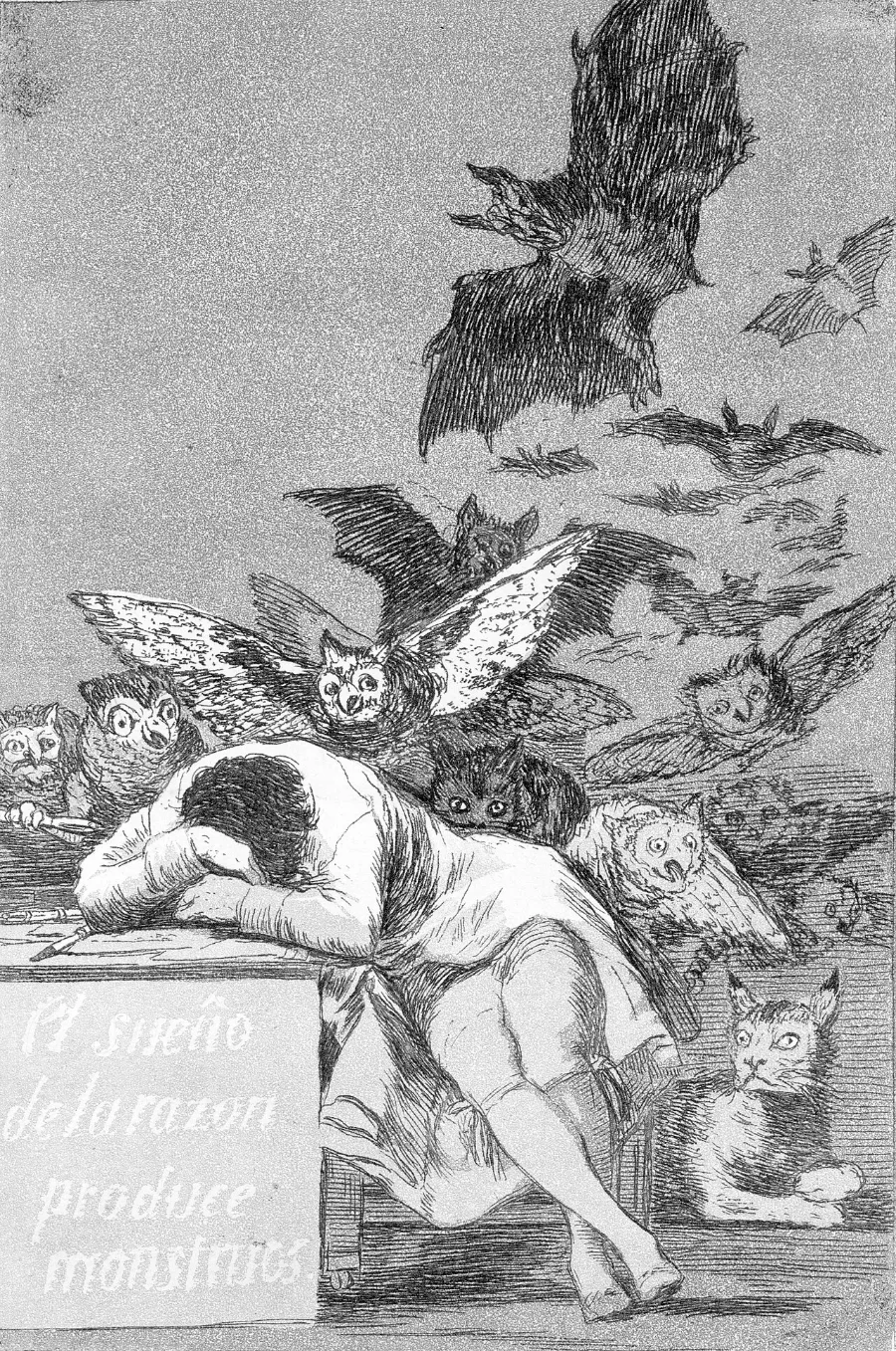
Goya put it in a title in 1799, more than a century before anyone said the word Surrealism: a man falls asleep over his desk, and owls and bats come up out of the dark behind him.
Look at a Surrealist scene and ask yourself four questions.
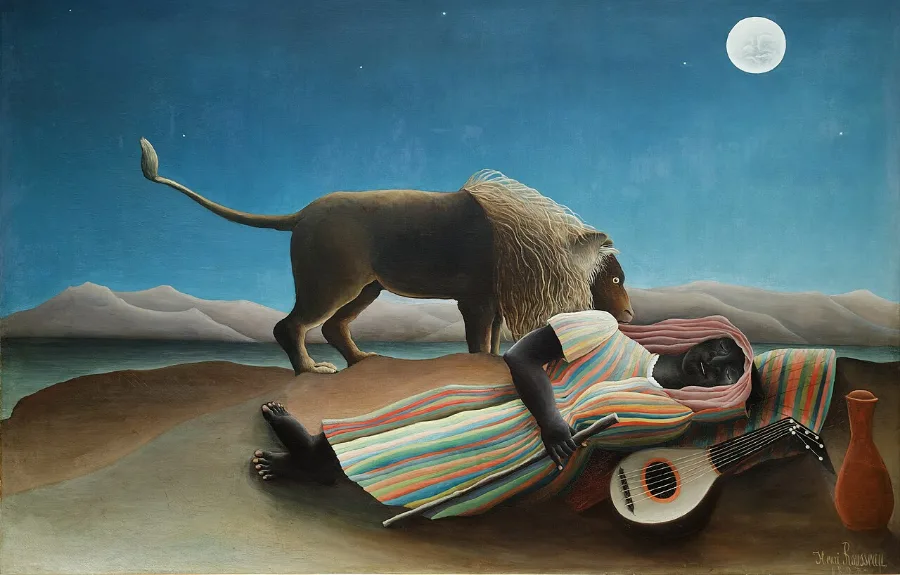
Or look at this one first. A lion has found somebody asleep in the desert under a full moon. Rousseau painted it in 1897 with no explanation whatsoever, and the Surrealists loved him for it.
Looking closely at our lagoon
Almost everything here is ordinary. Count how few things had to break. Press the numbers.
Pick a number
Each marker points at one thing this movement cared about.
Observation. Nothing here is frightening and nothing is loud. That is the method — take an ordinary evening and change one thing.
Fact card. Another scene we could have painted instead: a capybara walking along a long table that is somehow both underwater and in a desert, where the tablecloth ripples like a current, crumbs turn into constellations, tea pours upward out of a cup, and on a branch, instead of fruit, an old key is ripening. Perhaps the key opens a memory. Perhaps the tea party never began. Perhaps she is simply looking for the quietest orange.
Magritte: the mystery of the ordinary
René Magritte often painted simple things — hats, apples, windows, clouds — and placed them in impossible circumstances. His pictures look restrained and clear, which is precisely why the strangeness lands so hard.
Fact card. We take the principle, not the picture: a familiar object changes its scale, its place or its purpose. A bowler hat becomes a boat; an orange covers the moon. Our own riddle, not a repeat of his.
Worth knowing. There is a second reason you are looking at our drawing rather than his painting. A work stays in copyright for seventy years after the artist dies, and this chapter names four painters who are all still inside that: Magritte until 2038, Ernst until 2047, Miró until 2054 and Dalí until 2060. What we can show is Tanguy, who joined them in 1925 and died in 1955, and the older painters they pointed at as their ancestors.
Dalí: the precision of the impossible
Salvador Dalí painted fantastic scenes with almost photographic care. Smooth surfaces, long shadows and empty spaces made unbelievable transformations feel convincing.
In the capybara's world a boat gradually becomes a leaf, a stone flows along the bank, and footprints walk away across the sky. The more exactly the details are drawn, the more strongly you feel that reality has cracked.
Miró and Ernst: two roads for the imagination
Joan Miró
Turned figures, stars and animals into light signs, like a private visual alphabet. One road is to simplify the world down to lines, patches and constellations.
Max Ernst
Looked for images inside accidental textures, using frottage, grattage and collage. The other road is to let the surface itself suggest an unexpected creature.
Two capybaras could live on this screen at once: one assembled from free symbols, the other emerging out of rubbings of wood grain and leaves.
How to spot a Surrealist work
Ordinary objects joined in an unexpected way. Scale and space behaving implausibly. Dream, memory and the unconscious mattering more than an everyday subject. A realistic technique used to show the impossible. Chance marks and automatic lines turning into images. And a work that keeps its riddle, and allows more than one reading.
Worth knowing. Find three breaks with reality in any Surrealist picture and invent a possible reason for each. There are no wrong reasons — that is the exercise.
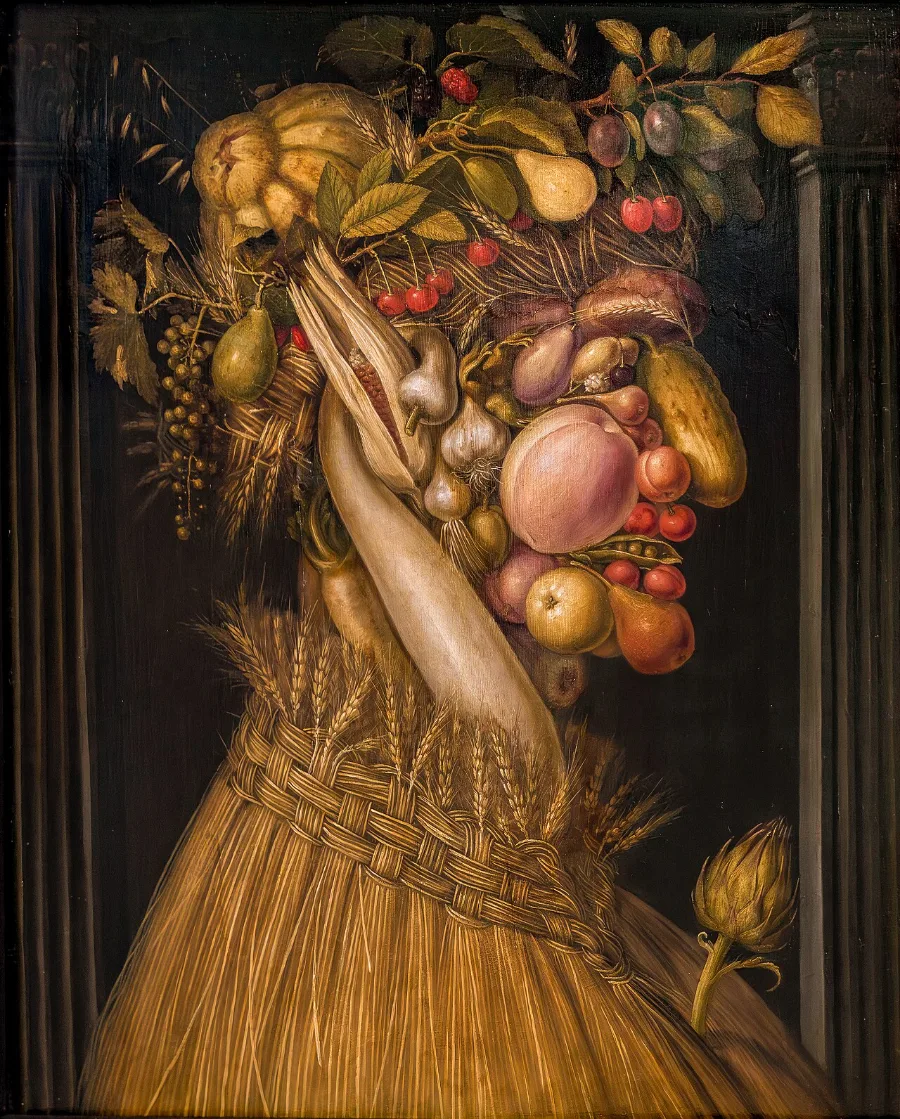
Practise on this one. It is more than three hundred years older than Surrealism, and it does the first thing on the list better than almost anything painted since: ordinary objects joined in an unexpected way. Every single part of the face is a fruit or a vegetable.
The game of impossible connections
Build a scene from three cards. Take one from each row without thinking about it too hard, and put them together exactly as they came out. The rule is the same as the one on the falling papers two chapters ago: you may choose the cards, but once they are down you have to work with what you got.
Creative workshop: your own Surrealist capybara
- Draw a capybara moving, or in an unusual pose.
- Add two familiar objects that have nothing to do with each other.
- Change the scale of one of them.
- Break one rule of space, light or reflection.
- Give the work a title that does not fully explain the riddle.
The strongest Surrealist pictures break one rule, not five. Break too many and the eye stops believing any of it — and a dream you do not believe is only a mess.
What to keep
“Surrealism does not ask you to give up reality. It suggests you look at which secret doors are already hidden inside it.”
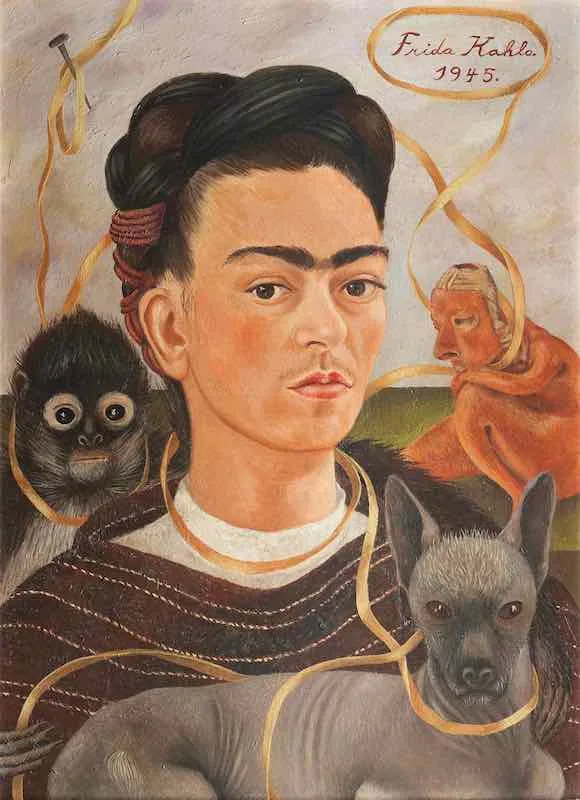
One last painter, and an argument. Frida Kahlo showed with the Surrealists and was claimed by them, and she would not have it: she said she had never painted a dream, only her own life. Both things can be true at once, and deciding what you think is a better exercise than being told.
Our capybara wakes up, and the door is just a door again. In the next chapter she meets painters who threw away the picture of anything at all, and kept only the movement of the arm that made it.
1. In which decade did Surrealism take shape?
The first manifesto was published in 1924.
2. Who published the first Manifesto of Surrealism?
Breton was a writer, and the movement began as much in words as in paint.
3. What did the Surrealists mean by automatism?
A way of getting past the part of the mind that edits everything.
4. Why does a realistic technique make a Surrealist scene stranger?
Dalí's smooth surfaces are what make his melting shapes so hard to dismiss.
5. Which technique is associated with Max Ernst?
He let the accidental texture propose the creature.
6. What is the surest way to turn an ordinary scene Surrealist?
One break, held steadily. More than that and the dream stops being believable.